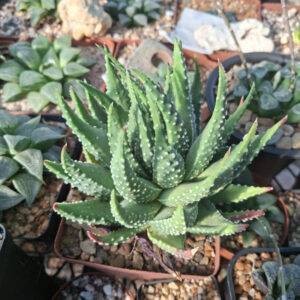
Gasteria ellaphieae is a compact, slow-growing succulent native to South Africa, specifically the Eastern Cape Province. It belongs to the Asphodelaceae family and is named in honor of botanical illustrator Ellaphie Ward-Hilhorst. This species is known for its attractive, thick, mottled leaves arranged in a distichous (fan-like) pattern. The foliage varies in shades of green with white or pale spots, and mature plants produce tubular pinkish-red flowers on slender stalks during late winter to spring. Gasteria ellaphieae prefers bright, indirect light and thrives in well-draining soil. It is drought-tolerant and should be watered sparingly—only when the soil is completely dry. Ideal for container gardening or rockeries, it requires protection from frost and excessive moisture. Propagation is best done through leaf cuttings or offsets.
Gasteria Ellaphieae
5 in stock
Gasteria ellaphieae is ’n kompakte, stadig-groeiende vetplant wat inheems is aan Suid-Afrika, spesifiek die Oos-Kaap. Dit behoort aan die Asphodelaceae-familie en is vernoem na die bekende plantillustreerder Ellaphie Ward-Hilhorst. Die plant word gekenmerk deur sy digte, vlesige blare wat in ’n waaierpatroon (distig) gerangskik is. Die blare is donkergroen met ligte of wit kolle, en volwasse plante dra buisvormige pienk-rooi blommetjies op dun stingels in die laat winter tot lente. Gasteria ellaphieae verkies helder, indirekte lig en goed dreinerende grond. Dit is droogtebestand en moet slegs natgemaak word wanneer die grond heeltemal droog is. Hierdie spesie is ideaal vir potte of rotstuine, maar moet beskerm word teen ryp en oormatige vog. Voortplanting geskied maklik via blaarstekke of sytakke (uitlopers).
R55.00
5 in stock
Shipping States: Eastern Cape (South Africa), Northern Cape (South Africa), Mpumalanga (South Africa), Limpopo (South Africa), KwaZulu-Natal (South Africa), Gauteng (South Africa), Western Cape (South Africa), Free State (South Africa), North West (South Africa)
Ready to ship in 3-5 business days
Shipping Policy
**Shipping Policy for Plants**
At MantisPlants, we take great care in preparing and shipping your plants to ensure they arrive in the best possible condition.
Bare Root Shipping
All plants are typically shipped bare-rooted, meaning that the soil is carefully removed from the roots to prevent any damage during transit. We wash the roots to remove any remaining soil and allow them to dry before wrapping them gently in tissue paper. This process helps minimize stress on the plant and ensures its safe arrival to you.
Pot Shipping Option (Not Recommended)
While we do offer the option of shipping some plants in their pots, this is generally not advisable. Shipping a plant in its pot can result in root damage due to movement and stress during transit. The roots can become constricted or disturbed, which can harm the plant. If you are still interested in this option, it must be arranged in advance with the vendor, and we will take extra precautions to pack it as securely as possible. However, we highly recommend the bare-root shipping method to ensure the best possible outcome for your plant.
**Careful Packaging**
We take pride in our packing process to ensure your plant arrives safely. Every plant is carefully packed, with extra attention to detail to protect the roots and foliage. We take care to secure the plant during transit, and make sure it is cushioned and stabilized inside the shipping box to avoid damage.
Our goal is to make sure your plant reaches you healthy and ready to thrive! If you have any questions about the shipping process, feel free to reach out to us.
| Weight | 0.3 kg |
|---|---|
| pot size | 7.5cm |
Based on 0 reviews
Only logged in customers who have purchased this product may leave a review.
Product Location
oudthoorn, South Africa-
Plants, Succulents & Cacti
Adromischus filicaulis ssp. marlothii
Oudtshoorn, WC
Adromischus filicaulis subsp. marlothii
Adromischus filicaulis subsp. marlothii is an attractive and unusual South African succulent known for its fleshy, elongated leaves, often displaying beautiful reddish-brown markings and speckles. The leaves grow along slender stems, forming compact, branching plants. Under bright light, the foliage can develop striking colours, making it a desirable addition to any succulent collection.
Origin: Native to South Africa, particularly the arid regions of the Western and Northern Cape.
Rarity: Uncommon in cultivation and sought after by collectors of South African succulents.
Care: Prefers bright, filtered sunlight, excellent drainage and careful watering. Allow the soil to dry between waterings. Protect from frost and excessive moisture.
A fascinating and collectible succulent, especially for enthusiasts of the genus Adromischus.
SKU: n/a -
Plants, Succulents & Cacti
Euphorbia Parvimedusae Hybrid (Yellow Flowers)
Oudtshoorn, WC
Euphorbia parvimedusae is sonder twyfel een van die mees opwindende nuwe ontdekkings van die afgelope paar jaar. Dit het op sigself groot ornamentele waarde—maar daar is meer. Hierdie spesie kan ’n sleutelrol speel in die toekomstige teel van struikagtige en stekelrige euphorbias. Net soos E. tulearensis ’n belangrike rol gespeel het in die teel van E. francoisii, kan Euphorbia parvimedusae alle struikagtige Euphorbia-spesies deur hibridisering kompakter en dwergagtig maak. Hierdie proses ontbloot ook soms verborge gene van elke spesie, wat soms tot verrassende resultate lei.
SKU: n/a -
Plants, Succulents & Cacti
Ornithogalum Species
Oudtshoorn, WC
Ornithogalum is a genus of bulbous flowering plants in the asparagus family (Asparagaceae), native mainly to southern Africa and parts of Europe and western Asia. The group includes many species commonly called “star-of-Bethlehem” due to their star-shaped flowers.
General characteristics:
- Grows from underground bulbs (geophytes).
- Produces narrow, strap-like green leaves.
- Flowers are typically star-shaped with 6 white (sometimes green-striped) petals.
- Many species open in sunlight and close in low light or at night.
- Flowering season varies by species, but many South African types bloom in spring.
Habitat:
- Found in grasslands, renosterveld, fynbos edges, and rocky or sandy soils.
- Many species are adapted to seasonal rainfall patterns (winter or summer rainfall depending on region).
Cultivation:
- Prefers well-drained soil and full sun.
- Requires a dry dormancy period after flowering when leaves die back.
- Water lightly during active growth; avoid overwatering during dormancy.
- Bulbs can multiply over time, forming clumps.
Notes:
- Some species are highly ornamental, while others are considered invasive outside their native range.
- A few species may be toxic to livestock if ingested.
SKU: n/a -
Plants, Succulents & Cacti
Anacampseros filamentosa subsp. tomentosa
Oudtshoorn, WC
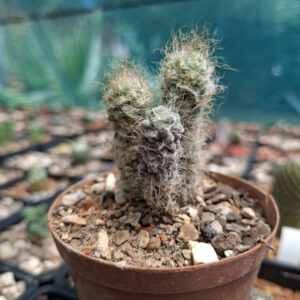
A fascinating, slow-growing miniature succulent native to the Little Karoo region of South Africa. This attractive Anacampseros forms compact, upright stems covered in fine, white, hair-like filaments, giving the plant a distinctive woolly appearance. Well adapted to the dry conditions of the Karoo, it is an excellent addition to any collection of rare and unusual succulents.
Origin: Oudtshoorn, Western Cape, South Africa.
Care: Bright light, excellent drainage and minimal watering. Protect from prolonged excessive moisture.
SKU: n/a -
Plants, Succulents & Cacti
Euphorbia parvimedusae hybrid
Oudtshoorn, WC
A Euphorbia parvimedusae hybrid is a cultivated succulent variety developed by crossing Euphorbia parvimedusae—a rare and unusual species from South Africa—with another Euphorbia species, often to enhance certain traits such as size, growth habit, or ease of cultivation. These hybrids typically retain the unique, medusoid appearance of the parent species, characterized by a central caudex (swollen stem base) from which numerous cylindrical arms or branches radiate, resembling a sea anemone or the mythological head of Medusa.
Depending on the hybrid cross, the plant may show variations in:
-
Branch density – more compact or sprawling arms
-
Caudex shape – larger, more prominent, or more textured
-
Color – shades of green, grey-green, or even reddish tones
-
Spines – some hybrids may have more or fewer spines
Like most Euphorbias, these hybrids exude a white, toxic latex when damaged and should be handled with care. They prefer well-draining soil, minimal watering, and bright light—making them excellent candidates for collectors or enthusiasts interested in rare succulents.
SKU: n/a -
Tulista Pumila (Haworthia Pumila)
Raspberry (Red)
Adromischus Marianae "Clanwilliam"
Haworthia Tessellata
Ariocarpus Retusus


There are no reviews yet.