



MantisPlants
- Oudtshoorn, Western Cape, South Africa
- +27712992189
-
Plants, Succulents & Cacti
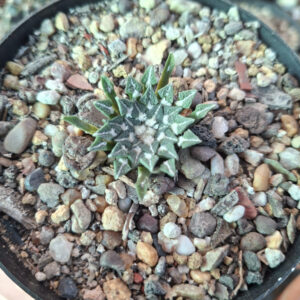
ariocarpus kotschoubeyanus, Seed Grown
Oudtshoorn, WC
Ariocarpus kotschoubeyanus is a very slow-growing, spineless cactus native to northern and central Mexico. It is famous for its ability to camouflage itself in the soil, often appearing like a flat rosette of grey-green or brownish tubercles at ground level.
Characteristics:
- Extremely low-growing, often flush with the soil surface.
- No visible spines; instead it has triangular, wart-like tubercles arranged in a rosette pattern.
- Body color blends with surrounding limestone or clay soils for camouflage.
- Produces striking flowers that emerge from the center, typically pink to magenta (sometimes white).
- Very slow growth; mature plants can take many years to reach flowering size.
Cultivation:
- Summer-growing cactus.
- Requires very well-drained, mineral-rich soil with low organic content.
- Water sparingly during active growth (spring–summer).
- Keep almost completely dry in winter dormancy.
- Needs strong light but benefits from protection against extreme heat buildup.
- Highly sensitive to overwatering and rot.
Habitat:
- Native to arid, limestone or clay soils in Mexico.
- Often grows partially buried in the ground, with only the upper surface exposed.
SKU: n/a -
Plants, Succulents & Cacti
Ariocarpus Kotschoubeyanus. Seed grown 4 years.
Oudtshoorn, WC
Ariocarpus kotschoubeyanus are very flat geophyte cacti that produce small star-shaped rosettes. They in most cases don’t reach more than only a few centimetres above the ground. Although they can form clumps, often only a small disc of tubercles can be seen flat at the soil surface, however these plants grow a large tap root below the surface of the compost.
SKU: n/a -
Plants, Succulents & Cacti
Astrophytum Asterias Nudum
Oudtshoorn, WC
Astrophytum asterias Nudum is a rare, spineless cactus prized for its smooth, unmarked surface and distinctively round, button-like shape. Its green to bluish-grey body is divided into symmetrical segments, creating a minimalist yet captivating appearance. In spring, this unique cactus crowns itself with bright yellow flowers, often with a striking orange center, adding to its visual appeal. Native to the deserts of Mexico and Texas, Astrophytum asterias Nudum is a true collector’s gem, blending simplicity with elegance.
SKU: n/a -
Plants, Succulents & Cacti
Astrophytum Caput Madusae
Oudtshoorn, WC
Description: Astrophytum Caput-Medusae is a rare and unusual cactus with long, snake-like tubercles that resemble the hair of Medusa. Its unique appearance and beautiful yellow flowers make it a prized specimen for collectors and exotic plant enthusiasts.
Origin: Native to the desert regions of Mexico, where it grows in rocky, well-drained soils under intense sunlight.
Care:
- Light: Bright light to full sun
- Water: Water sparingly and allow soil to dry completely between waterings
- Soil: Fast-draining cactus mix with added grit or pumice
- Temperature: Protect from frost and excessive moisture
- Growth: Slow-growing and ideal for pots and collector displays
SKU: n/a -
Plants, Succulents & Cacti
Astrophytum Myriostigma Fukuryu
Oudtshoorn, WC
The Astrophytum Myriostigma Fukuryu is a rare and striking cactus prized for its unique, wavy ribs and textured white speckles that resemble a starry sky. Its distinctive appearance, combined with its ease of care, makes it a must-have for collectors and enthusiasts. Perfect for adding elegance to any succulent collection or home decor.
SKU: n/a -
Plants, Succulents & Cacti
Astrophytum Myriostigma Fukuryu Nudum
Oudtshoorn, WC
Astrophytum Myriostigma Fukuryu Nudum, commonly known as the “Bishop’s Cap Cactus,” is a rare and unique cactus variety characterized by its smooth, spineless, and glossy green skin. The “Fukuryu” variant features fascinating ridges and patterns that add to its visual appeal. It typically grows in a star-shaped form with multiple ribs, making it a favorite among cactus collectors.
SKU: n/a -
Plants, Succulents & Cacti
Astrophytum Myriostigma Nudum 5 RIB
Oudtshoorn, WC
Astrophytum Myriostigma Nudum is very similar to the other myriostigma, it only deviate from the well-known typical form for lacking or mostly lacking white flecks, giving a bright green, blue-green, gray-green or mauve-green color overall depending on clones.
SKU: n/a -
Plants, Succulents & Cacti
Astrophytum Myriostigma Tricostatum
Oudtshoorn, WC
Astrophytum Myriostigma var. quadricostatum, also known as the “Bishop’s Cap Cactus,” is a distinctive, spineless cactus with four prominent ribs, giving it a star-shaped appearance. Native to Mexico, this cactus is covered with tiny white dots that help it retain water in dry climates. It’s a great choice for collectors due to its unique look and easy care.
Care Instructions:
- Light: Prefers bright, indirect sunlight; a few hours of direct morning sun is beneficial.
- Water: Water sparingly, especially during winter. Allow the soil to dry completely between waterings to prevent rot.
- Soil: Use a well-draining cactus soil mix, ideally with added grit or sand.
- Temperature: Thrives in warm conditions (20-30°C) but can tolerate cooler temperatures down to around 5°C if kept dry.
- Humidity: Low humidity is best.
- Fertilizer: Apply a diluted cactus fertilizer during the growing season (spring and summer).
SKU: n/a -
Plants, Succulents & Cacti
Astrophytum Myriostigma Tricostatum
Oudtshoorn, WC
Astrophytum myriostigma var. tricostatum is a rare and visually striking variety of the Bishop’s Cap cactus, native to Mexico. Unlike the typical five-ribbed form, this variety usually has only three prominent ribs (hence “tricostatum”). It has a smooth, spineless surface covered with tiny white speckles that give it a starry appearance. The cactus produces yellow, daisy-like flowers at the top during spring or summer. Due to its unique shape and low-maintenance care needs, it is highly sought after by collectors and succulent enthusiasts.
SKU: n/a -
Plants, Succulents & Cacti
Astrophytum Myriostigma Tricostatum
Oudtshoorn, WC
Astrophytum myriostigma var. tricostatum is a rare and visually striking variety of the Bishop’s Cap cactus, native to Mexico. Unlike the typical five-ribbed form, this variety usually has only three prominent ribs (hence “tricostatum”). It has a smooth, spineless surface covered with tiny white speckles that give it a starry appearance. The cactus produces yellow, daisy-like flowers at the top during spring or summer. Due to its unique shape and low-maintenance care needs, it is highly sought after by collectors and succulent enthusiasts.
SKU: n/a -
Plants, Succulents & Cacti
Cereus Peruvianus f. monstruosa variegata
Oudtshoorn, WC
Cereus peruvianus f. monstruosa variegata is a striking, fast-growing cactus known for its unusual, contorted “monstrose” stems and beautiful variegated coloring in shades of green, cream, and white. Its bold, architectural form makes it a standout specimen for gardens, containers, and succulent collections. This hardy cactus thrives in full sun and well-drained soil and may produce large, fragrant white flowers during the summer.
SKU: n/a -
Plants, Succulents & Cacti
Conophytum Bilobum
Oudtshoorn, WC
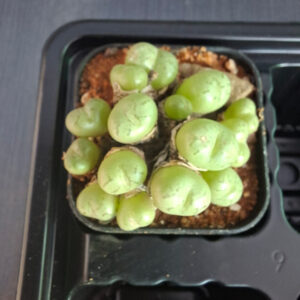
Conophytum bilobum is a small, winter-growing succulent native to the Western and Northern Cape regions of South Africa. It is one of the larger and easier-to-grow species in the genus and is recognized by its two-lobed body shape.
Characteristics:
- Forms pairs of fleshy leaves fused at the base, creating a distinct heart-shaped or two-lobed appearance.
- Bodies are usually green to grey-green and may develop reddish margins in strong light.
- Grows in clusters that gradually form dense mats.
- Produces bright yellow, daisy-like flowers in autumn, often larger than the plant body itself.
- During summer dormancy, the old leaves dry into a protective papery sheath.
Cultivation:
- Winter-growing; active from autumn through spring.
- Requires a very well-drained, gritty soil mix.
- Water sparingly during active growth.
- Keep almost completely dry during summer dormancy.
- Prefers bright light and good air circulation.
SKU: n/a -
Plants, Succulents & Cacti
Conophytum Flavum
Oudtshoorn, WC
Conophytum flavum is a small, winter-growing succulent native to the arid regions of Namaqualand in South Africa and southern Namibia. The species name flavum means “yellow,” referring to its bright yellow flowers.
Characteristics:
- Forms compact clumps of small, rounded to slightly cone-shaped bodies.
- Bodies are usually pale green, grey-green, or bluish-green.
- The surface may be smooth or finely marked, depending on the variety.
- Produces bright yellow, daisy-like flowers in autumn, often opening during the afternoon.
- Old leaves dry into a thin papery sheath during summer dormancy.
Cultivation:
- Winter-growing with a summer resting period.
- Requires excellent drainage and a mineral-rich soil mix.
- Water lightly from autumn through spring.
- Keep almost completely dry during summer dormancy.
- Prefers bright light and good ventilation.
SKU: n/a -
Plants, Succulents & Cacti
Conophytum Obcoredelumn. With Seed Pod
Oudtshoorn, WC
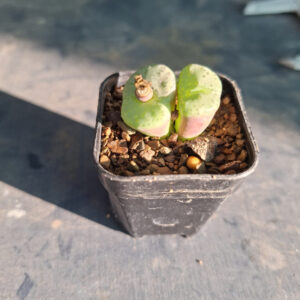
Conophytum obcordellum is a miniature, winter-growing succulent native to the arid regions of South Africa, especially Namaqualand. It is one of the most popular Conophytum species among collectors because of its attractive markings and compact growth.
Characteristics:
- Forms small, paired succulent bodies that are fused into a single rounded structure.
- The tops are often flattened and decorated with intricate patterns of dots, lines, or translucent windows.
- Body color ranges from grey-green to bluish-green, sometimes with reddish markings.
- Produces relatively large flowers, usually yellow, pink, purple, or white depending on the form.
- Grows in clusters over time.
Cultivation:
- Winter-growing and summer-dormant.
- Requires very well-drained soil.
- Water moderately during active growth (autumn to spring).
- Keep almost completely dry during summer dormancy.
- Prefers bright light but protection from intense summer sun.
SKU: n/a -
Plants, Succulents & Cacti
Conp[hytum Uviforme
Oudtshoorn, WC
Conophytum uviforme is a small, winter-growing succulent native to the arid regions of the Northern Cape of South Africa and southern Namibia. The species name uviforme means “grape-shaped,” referring to its rounded bodies that resemble tiny grapes.
Characteristics:
- Forms dense clusters of small, rounded to slightly elongated bodies.
- Bodies are typically green, grey-green, bluish-green, or sometimes reddish when exposed to strong light.
- The surface may be smooth or finely spotted, depending on the variety.
- Produces attractive flowers in autumn, commonly yellow, pink, purple, or white.
- Over time, forms large cushion-like clumps.
Cultivation:
- Winter-growing and summer-dormant.
- Requires excellent drainage and a mineral-rich growing medium.
- Water lightly during the active growing season (autumn to spring).
- Keep nearly dry during summer dormancy.
- Prefers bright light and good air circulation.
SKU: n/a -
Plants, Succulents & Cacti
Copiapoa Hypogaea
Oudtshoorn, WC
Copiapoa hypogaea is a rare and slow-growing cactus species native to the Atacama Desert in northern Chile. It has a low, often subterranean growth habit, with globular to slightly flattened stems that are typically dark grey to brownish in color. The plant is covered in fine, short spines or can even appear spineless. It produces beautiful yellow flowers from the crown, usually in summer. Due to its unique appearance and adaptation to extremely arid conditions, Copiapoa hypogaea is highly prized among cactus collectors.
SKU: n/a -
Plants, Succulents & Cacti
Copiapoa Hypogaea cv. Lizard Skin
Oudtshoorn, WC
The Copiapoa hypogaea cv. Lizard Skin is a rare and unique cultivar native to the arid regions of northern Chile. Its textured, reptilian-like surface sets it apart as a true collector’s gem. Compact and slow-growing, this succulent thrives in well-drained soil and bright sunlight, making it a must-have for cacti enthusiasts. With its limited availability and striking appearance, the “Lizard Skin” cultivar adds both intrigue and exclusivity to any collection. Don’t miss the opportunity to own this fascinating specimen!
SKU: n/a -
Plants, Succulents & Cacti
Copiapoa Hypogaea cv.Lizzard Skin
Oudtshoorn, WC
Copiapoa hypogea cv. Lizard Skin is a unique and stunning cactus variety known for its distinctive, textured skin resembling lizard scales. Native to the Atacama Desert in Chile, this cultivar has a slow growth rate and features spiny, spherical bodies that are a deep green color. It thrives in arid environments and makes an eye-catching addition to succulent collections due to its striking appearance and resilience.
SKU: 1-1-2-1-2-1-1-1 -
Plants, Succulents & Cacti
Copiapoa Laui
Oudtshoorn, WC
Copiapoa laui is a rare and highly sought-after cactus known for its compact, rounded form and dense covering of fine spines. Its grey-green to silvery body gives it a distinctive, sculptural appearance. During the growing season, it produces small yellow flowers from the crown. This slow-growing species thrives in bright light and well-drained soil, making it ideal for collectors and arid garden settings.
Care Instructions:
- Light: Requires bright, indirect sunlight. Avoid direct sunlight to prevent scorching the colorful tops.
- Water: Water sparingly, allowing the soil to dry out completely between waterings. During the growing season (spring and summer), water more frequently, but reduce watering in fall and winter.
- Soil: Use a well-draining cactus mix to prevent root rot.
- Temperature: Thrives in warm conditions, ideally between 18-30°C (65-86°F). Protect from frost and cold drafts.
SKU: n/a -
Plants, Succulents & Cacti
Coryphantha Elephantidens Inermis
Oudtshoorn, WC
The Coryphantha elephantidens inermis is a rare, spineless variety of the beloved Coryphantha elephantidens. With its smooth, rounded body and striking deep green color, this cactus is an eye-catching addition to any collection. It produces beautiful pink to magenta flowers, making it even more desirable. Unlike many other cacti, its lack of spines makes it easy to handle. Interesting fact: This species stores water in its thick, fleshy tubercles, allowing it to survive long dry periods with ease!
SKU: 1-1-1-1