





Gasteria Lilliputana
5 in stock
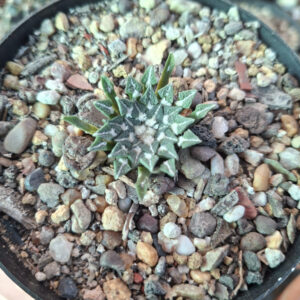
Gasteria lilliputana is a tiny, yet striking succulent native to South Africa. This miniature plant features thick, fleshy leaves that form a dense rosette, with dark green to greyish-green coloring and distinctive white markings or spots. The leaves are rough to the touch, giving it a unique texture that stands out in succulent collections. In late winter or early spring, it produces small, tubular flowers in shades of pink or red, adding a pop of color to its compact form. Interesting fact: Despite its small size, Gasteria lilliputana is extremely hardy and can tolerate drought and neglect, making it an ideal choice for beginner succulent growers. Its slow-growing nature also means it requires minimal maintenance and thrives in bright, indirect light.
R35.00
5 in stock
Gasteria lilliputana is ‘n klein, maar indrukwekkende vetplant wat oorspronklik uit Suid-Afrika kom. Hierdie miniatuurplant het dik, vlesige blare wat ‘n digte roset vorm, met donker groen tot grys-groen kleur en kenmerkende wit kolle of merke. Die blare is growwe om aan te raak, wat dit ‘n unieke tekstuur gee wat uitstaan in vetplantversamelings. In die laat winter of vroeë lente, produseer dit klein, buisvormige blomme in skakerings van pienk of rooi, wat ‘n kleurvolle aksent by sy kompakte vorm voeg. Interessante feit: Ten spyte van sy klein grootte, is Gasteria lilliputana uiters taai en kan dit droogte en verwaarlozing verdra, wat dit ‘n ideale keuse maak vir beginners wat vetplante kweek. Sy stadig-groeiende aard beteken ook dat dit min onderhoud benodig en floreer in helder, indirekte lig.
Ready to ship in 3-5 business days
Shipping Policy
**Shipping Policy for Plants**
At MantisPlants, we take great care in preparing and shipping your plants to ensure they arrive in the best possible condition.
Bare Root Shipping
All plants are typically shipped bare-rooted, meaning that the soil is carefully removed from the roots to prevent any damage during transit. We wash the roots to remove any remaining soil and allow them to dry before wrapping them gently in tissue paper. This process helps minimize stress on the plant and ensures its safe arrival to you.
Pot Shipping Option (Not Recommended)
While we do offer the option of shipping some plants in their pots, this is generally not advisable. Shipping a plant in its pot can result in root damage due to movement and stress during transit. The roots can become constricted or disturbed, which can harm the plant. If you are still interested in this option, it must be arranged in advance with the vendor, and we will take extra precautions to pack it as securely as possible. However, we highly recommend the bare-root shipping method to ensure the best possible outcome for your plant.
**Careful Packaging**
We take pride in our packing process to ensure your plant arrives safely. Every plant is carefully packed, with extra attention to detail to protect the roots and foliage. We take care to secure the plant during transit, and make sure it is cushioned and stabilized inside the shipping box to avoid damage.
Our goal is to make sure your plant reaches you healthy and ready to thrive! If you have any questions about the shipping process, feel free to reach out to us.
| Weight | 0.3 kg |
|---|---|
| pot size | 7.5cm |
Gasteria lilliputana is a tiny, yet striking succulent native to South Africa.
Based on 0 reviews
Only logged in customers who have purchased this product may leave a review.
Product Location
oudthoorn, South Africa-
Plants, Succulents & Cacti
Euphorbia Abdulkuri
Oudtshoorn, WC
Description: Euphorbia Abdulkuri is a rare and highly collectible succulent known for its smooth, pencil-like stems and unusual grey-green colour. Its sculptural form and drought tolerance make it a striking feature plant for succulent collections and modern displays.
Origin: Native to Abd al Kuri Island near Yemen, where it grows in harsh, rocky desert conditions.
Care:
- Light: Bright light to full sun
- Water: Water sparingly and allow soil to dry completely between waterings
- Soil: Well-draining cactus or succulent mix
- Temperature: Protect from frost and cold temperatures
- Growth: Slow-growing and ideal for pots and collector displays
Note: Like most Euphorbias, the sap can irritate skin and eyes if handled carelessly.
SKU: n/a -
Plants, Succulents & Cacti
ariocarpus kotschoubeyanus, Seed Grown
Oudtshoorn, WC
Ariocarpus kotschoubeyanus is a very slow-growing, spineless cactus native to northern and central Mexico. It is famous for its ability to camouflage itself in the soil, often appearing like a flat rosette of grey-green or brownish tubercles at ground level.
Characteristics:
- Extremely low-growing, often flush with the soil surface.
- No visible spines; instead it has triangular, wart-like tubercles arranged in a rosette pattern.
- Body color blends with surrounding limestone or clay soils for camouflage.
- Produces striking flowers that emerge from the center, typically pink to magenta (sometimes white).
- Very slow growth; mature plants can take many years to reach flowering size.
Cultivation:
- Summer-growing cactus.
- Requires very well-drained, mineral-rich soil with low organic content.
- Water sparingly during active growth (spring–summer).
- Keep almost completely dry in winter dormancy.
- Needs strong light but benefits from protection against extreme heat buildup.
- Highly sensitive to overwatering and rot.
Habitat:
- Native to arid, limestone or clay soils in Mexico.
- Often grows partially buried in the ground, with only the upper surface exposed.
SKU: n/a -
Plants, Succulents & Cacti
Agave Titanota
Oudtshoorn, WC
Agave Titanota is a stunning, slow-growing succulent that features striking blue-gray leaves with bold white margins. Known for its dramatic appearance, this hardy plant thrives in well-draining soil and full sunlight. Perfect for xeriscaping or adding a unique touch to your garden, it can also be grown in containers. It’s an ideal choice for collectors or anyone looking for a low-maintenance yet visually impressive plant.
SKU: n/a -
Plants, Succulents & Cacti
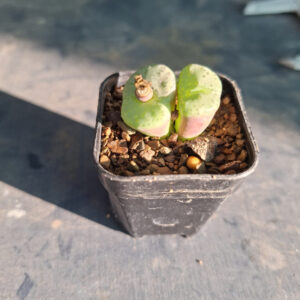
Conophytum Obcoredelumn. With Seed Pod
Oudtshoorn, WC
Conophytum obcordellum is a miniature, winter-growing succulent native to the arid regions of South Africa, especially Namaqualand. It is one of the most popular Conophytum species among collectors because of its attractive markings and compact growth.
Characteristics:
- Forms small, paired succulent bodies that are fused into a single rounded structure.
- The tops are often flattened and decorated with intricate patterns of dots, lines, or translucent windows.
- Body color ranges from grey-green to bluish-green, sometimes with reddish markings.
- Produces relatively large flowers, usually yellow, pink, purple, or white depending on the form.
- Grows in clusters over time.
Cultivation:
- Winter-growing and summer-dormant.
- Requires very well-drained soil.
- Water moderately during active growth (autumn to spring).
- Keep almost completely dry during summer dormancy.
- Prefers bright light but protection from intense summer sun.
SKU: n/a -
Plants, Succulents & Cacti
Gymnocalycium mihanovichii Hybrids
Oudtshoorn, WC
Gymnocalycium mihanovichii is a small, globular cactus species native to the semi-arid regions of Paraguay and parts of northern Argentina. It belongs to the Cactaceae family and is part of a genus known for its relatively easy care, compact size, and attractive flowers.
This species typically grows to about 5–6 cm in height and 4–5 cm in diameter. It has a flattened, spherical body with 8–14 broad ribs and a grayish-green to dark green color. The stem is often slightly wrinkled and marked by low tubercles. It bears short, slightly curved spines that vary in number but are generally not aggressive, making the plant user-friendly for handling.
Flowers appear from the crown of the plant during late spring to summer. They are funnel-shaped and range in color from pale pink to light purple, occasionally white. The blooms are relatively large compared to the size of the plant and open during the day.
This species prefers well-draining cactus soil, moderate watering (allowing the soil to dry completely between waterings), and bright, indirect sunlight. Direct sun in hot climates can cause sunburn on the plant’s surface. It tolerates mild cold but should be protected from frost.
In cultivation, Gymnocalycium mihanovichii is often the parent of colorful grafted hybrids like the “Moon Cactus” (var. friedrichii), which lacks chlorophyll and must be grafted onto a host plant to survive.
SKU: n/a



Related products
-
Plants, Succulents & Cacti
Stenocactus multicostatus
Oudtshoorn, WC
Stenocactus multicostatus is a distinctive cactus known for its many thin, wavy ribs that create a beautifully textured, spherical form. Its intricate structure gives it a sculptural appearance, while delicate flowers in shades of white to pale pink often bloom from the crown. This compact cactus thrives in bright light and well-drained soil, making it an excellent choice for containers and specialist cactus collections.
SKU: n/a -
Plants, Succulents & Cacti
Gasteria Batesiana
Oudtshoorn, WC
Gasteria Batesiana, a striking succulent native to the rocky terrains of South Africa, is a must-have for any plant enthusiast. With its thick, glossy, dark green leaves adorned with pale white spots, it adds a touch of the exotic to any collection. This hardy plant thrives in well-draining soil and enjoys bright, indirect light. Minimal watering is required, making it perfect for low-maintenance care. Its unique appearance and resilience make Gasteria Batesiana a captivating addition to both indoor and outdoor gardens.
SKU: n/a -
Plants, Succulents & Cacti
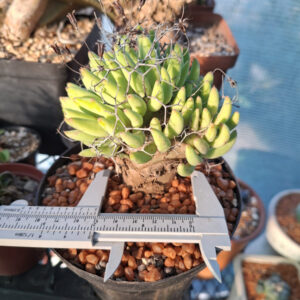
Variegated Aloe Hybrid
Oudtshoorn, WC
The Variegated Aloe Hybrid is a striking succulent, known for its unique, patterned leaves that feature shades of green, white, and yellow. This hardy plant thrives in dry, sunny conditions and adds a touch of elegance to any garden or indoor space with its bold, architectural form.
SKU: n/a


There are no reviews yet.