







Obregonia Denegrii
2 in stock
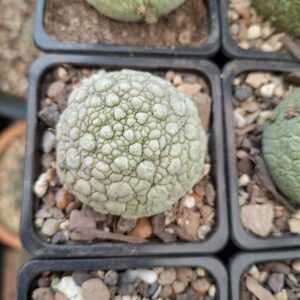
: Obregonia denegrii, also known as the Artichoke Cactus, is a rare, slow-growing cactus native to northeastern Mexico. It has a unique, spiral rosette resembling an artichoke. For optimal growth, plant it in well-draining cactus soil and place it in a spot with full sun to partial shade. Water sparingly, allowing the soil to dry completely between waterings, especially in winter. An interesting fact about Obregonia denegrii is that it is the only species in its genus, making it a distinct and prized specimen among cactus enthusiasts.
R220.00
2 in stock
Obregonia denegrii, ook bekend as die Artisjok Kaktus, is ‘n seldsame, stadig groeiende kaktus wat in die noordooste van Mexiko voorkom. Dit het ‘n unieke, spiraalvormige roset wat soos ‘n artisjok lyk. Vir optimale groei, plant dit in goed-drainerende kaktusgrond en plaas dit in ‘n plek met volle son tot gedeeltelike skadu. Water spaarsamig en laat die grond heeltemal uitdroog tussen waterings, veral in die winter. ‘n Interessante feit oor Obregonia denegrii is dat dit die enigste spesie in sy genus is, wat dit ‘n unieke en gesogte spesimen onder kaktusliefhebbers maak.
Ready to ship in 3-5 business days
Shipping Policy
**Shipping Policy for Plants**
At MantisPlants, we take great care in preparing and shipping your plants to ensure they arrive in the best possible condition.
Bare Root Shipping
All plants are typically shipped bare-rooted, meaning that the soil is carefully removed from the roots to prevent any damage during transit. We wash the roots to remove any remaining soil and allow them to dry before wrapping them gently in tissue paper. This process helps minimize stress on the plant and ensures its safe arrival to you.
Pot Shipping Option (Not Recommended)
While we do offer the option of shipping some plants in their pots, this is generally not advisable. Shipping a plant in its pot can result in root damage due to movement and stress during transit. The roots can become constricted or disturbed, which can harm the plant. If you are still interested in this option, it must be arranged in advance with the vendor, and we will take extra precautions to pack it as securely as possible. However, we highly recommend the bare-root shipping method to ensure the best possible outcome for your plant.
**Careful Packaging**
We take pride in our packing process to ensure your plant arrives safely. Every plant is carefully packed, with extra attention to detail to protect the roots and foliage. We take care to secure the plant during transit, and make sure it is cushioned and stabilized inside the shipping box to avoid damage.
Our goal is to make sure your plant reaches you healthy and ready to thrive! If you have any questions about the shipping process, feel free to reach out to us.
| Weight | 0.3 kg |
|---|---|
| pot size | 7.5cm |
Based on 0 reviews
Only logged in customers who have purchased this product may leave a review.
Product Location
oudthoorn, South Africa-
Plants, Succulents & Cacti
Astrophytum Myriostigma Nudum 5 RIB
Oudtshoorn, WC
Astrophytum Myriostigma Nudum is very similar to the other myriostigma, it only deviate from the well-known typical form for lacking or mostly lacking white flecks, giving a bright green, blue-green, gray-green or mauve-green color overall depending on clones.
SKU: n/a -
Plants, Succulents & Cacti
Haworthia Scabra var Scabra
Oudtshoorn, WC
Haworthia scabra var. scabra
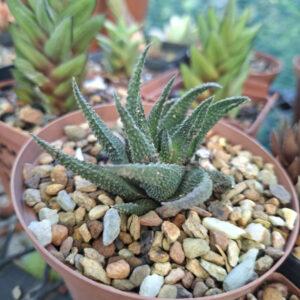
A tough yet beautifully textured succulent, Haworthia scabra var. scabra is known for its elongated rosettes of firm, dark green leaves covered in rough, sandpaper-like ridges. Its rugged surface and upright growth give it a distinctive, hardy appearance that contrasts nicely with smoother succulents in any collection.
This resilient species is well-suited to a variety of conditions, thriving in bright, indirect light with minimal watering. Its durability and unique texture make it an excellent choice for both beginners and collectors.
Interesting fact:
The name “scabra” means “rough” or “scaly,” referring to the plant’s coarse leaf texture—an adaptation that helps reduce water loss in its natural habitat.SKU: n/a -
-
Plants, Succulents & Cacti
Turbinicarpus Pseudopectinatus
Oudtshoorn, WC
A true collector’s gem, Turbinicarpus pseudopectinatus is a small, slow-growing cactus prized for its neat, geometric form and striking spine patterns. Its flattened, grey-green body is covered in fine, comb-like (pectinate) spines that create an almost sculpted, symmetrical appearance. In spring, it surprises with delicate pink to lavender flowers that add a soft contrast to its structured look.
Ideal for collectors and small-space displays, this species thrives in bright light with careful, minimal watering—making it both rewarding and low-maintenance when grown correctly.
Interesting fact:
The name “pseudopectinatus” means “false comb-like,” referring to its spines that resemble those of related species—but with subtle differences that make it highly sought after by enthusiasts and collectors.SKU: n/a -
Plants, Succulents & Cacti
Gasteria Glomerata
Oudtshoorn, WC
Gasteria glomerata is a compact, slow-growing succulent native to the Eastern Cape province of South Africa. It forms small, dense clusters of short, tongue-shaped leaves that are smooth, grey-green, and often speckled with white. The leaves grow in pairs, forming a neat fan shape.
In spring, it produces slender flower stalks with tubular, two-toned pink and greenish flowers, typical of the Gasteria genus. Gasteria glomerata thrives in bright, indirect light, well-draining soil, and infrequent watering—making it an ideal choice for indoor succulent collections.
SKU: n/a -
Plants, Succulents & Cacti
Euphorbia parvimedusae hybrid
Oudtshoorn, WC
A Euphorbia parvimedusae hybrid is a cultivated succulent variety developed by crossing Euphorbia parvimedusae—a rare and unusual species from South Africa—with another Euphorbia species, often to enhance certain traits such as size, growth habit, or ease of cultivation. These hybrids typically retain the unique, medusoid appearance of the parent species, characterized by a central caudex (swollen stem base) from which numerous cylindrical arms or branches radiate, resembling a sea anemone or the mythological head of Medusa.
Depending on the hybrid cross, the plant may show variations in:
-
Branch density – more compact or sprawling arms
-
Caudex shape – larger, more prominent, or more textured
-
Color – shades of green, grey-green, or even reddish tones
-
Spines – some hybrids may have more or fewer spines
Like most Euphorbias, these hybrids exude a white, toxic latex when damaged and should be handled with care. They prefer well-draining soil, minimal watering, and bright light—making them excellent candidates for collectors or enthusiasts interested in rare succulents.
SKU: n/a -



Related products
-
-
Plants, Succulents & Cacti
Euphorbia Pulvinata (Meloformis Variegated)
Oudtshoorn, WC
Euphorbia pulvinata is a small, cushion-forming succulent native to South Africa. It grows in dense, rounded clumps that resemble little green pillows, hence the name “pulvinata,” which means “cushion-like.” This plant has short, thick stems covered in small tubercles and spines, giving it a textured appearance. In spring to early summer, it produces tiny, yellow-green flowers (cyathia) at the tips of its stems. Like most euphorbias, it contains a milky sap that can be irritating to the skin and toxic if ingested. It thrives in full sun with well-draining soil and is ideal for rock gardens, containers, or succulent collections.
SKU: 1-1-2-1-2-2-1-1 -
Plants, Succulents & Cacti
Astrophytum Myriostigma Fukuryu
Oudtshoorn, WC
The Astrophytum Myriostigma Fukuryu is a rare and striking cactus prized for its unique, wavy ribs and textured white speckles that resemble a starry sky. Its distinctive appearance, combined with its ease of care, makes it a must-have for collectors and enthusiasts. Perfect for adding elegance to any succulent collection or home decor.
SKU: n/a -
Plants, Succulents & Cacti
Kalanchoe beharensis ‘Fang’
Raithby, WC
Kalanchoe beharensis ‘Fang’
Noted for its eccentric appearance, award-winning Kalanchoe beharensis ‘Fang’ (Felt Plant) is a bushy, often tree-like perennial succulent, with velvety, triangular to lance-shaped, long-stalked leaves. Bronze or green on the upper surface, with silver-gray undersides, the large fleshy leaves, up to 4 in.
For sale in South Africa.
SKU: n/a


There are no reviews yet.