
-
×
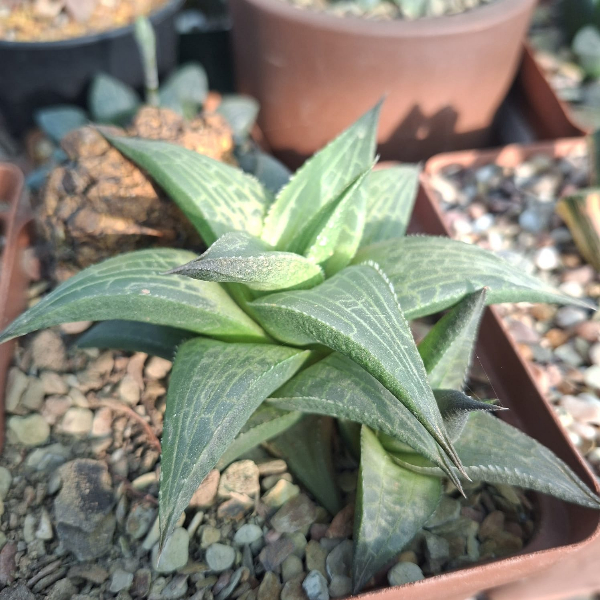
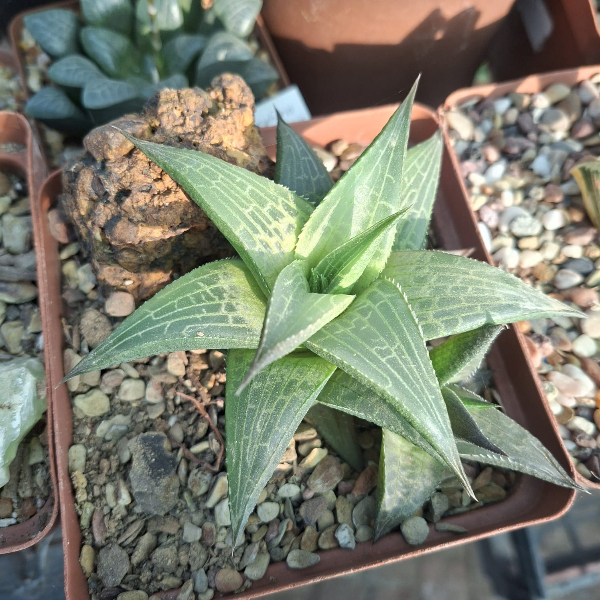
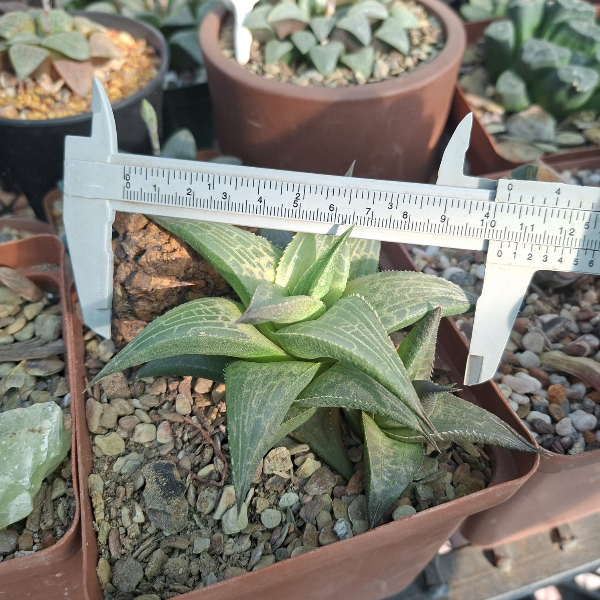
 Tulista Pumila, Haworthia Pumila
- Vendor:
MantisPlants
Subtotal: R200.00
1 in stock
Haworthia tessellata is a small, slow-growing succulent native to southern Africa. It is known for its distinctive, thick, triangular leaves that form a rosette. The leaves are dark green to brownish and feature a unique, tessellated (checkerboard-like) pattern on their surface, which gives the plant its name. This pattern helps it blend into its natural rocky surroundings. Haworthia tessellata prefers indirect light and well-draining soil, making it an excellent and easy-to-care-for houseplant.
R175.00
1 in stock
Haworthia tessellata is ‘n klein, stadig-groeiende vetplant wat in Suidelike Afrika voorkom. Dit is bekend vir sy kenmerkende, dik, driehoekige blare wat in ‘n roset groei. Die blare is donkergroen tot bruinig en het ‘n unieke, geteëlde (blokvormige) patroon op die oppervlak, wat aan die plant sy naam gee. Hierdie patroon help dit om in sy natuurlike rotsagtige omgewing weg te smelt. Haworthia tessellata verkies indirekte lig en goed dreinerende grond, en is ‘n uitstekende, maklik-versorgbare huisplant.
Shipping States: Gauteng (South Africa), Western Cape (South Africa), Free State (South Africa), North West (South Africa), Eastern Cape (South Africa), Northern Cape (South Africa), Mpumalanga (South Africa), Limpopo (South Africa), KwaZulu-Natal (South Africa)
Ready to ship in 3-5 business days
Shipping Policy
**Shipping Policy for Plants**
At MantisPlants, we take great care in preparing and shipping your plants to ensure they arrive in the best possible condition.
Bare Root Shipping
All plants are typically shipped bare-rooted, meaning that the soil is carefully removed from the roots to prevent any damage during transit. We wash the roots to remove any remaining soil and allow them to dry before wrapping them gently in tissue paper. This process helps minimize stress on the plant and ensures its safe arrival to you.
Pot Shipping Option (Not Recommended)
While we do offer the option of shipping some plants in their pots, this is generally not advisable. Shipping a plant in its pot can result in root damage due to movement and stress during transit. The roots can become constricted or disturbed, which can harm the plant. If you are still interested in this option, it must be arranged in advance with the vendor, and we will take extra precautions to pack it as securely as possible. However, we highly recommend the bare-root shipping method to ensure the best possible outcome for your plant.
**Careful Packaging**
We take pride in our packing process to ensure your plant arrives safely. Every plant is carefully packed, with extra attention to detail to protect the roots and foliage. We take care to secure the plant during transit, and make sure it is cushioned and stabilized inside the shipping box to avoid damage.
Our goal is to make sure your plant reaches you healthy and ready to thrive! If you have any questions about the shipping process, feel free to reach out to us.
| Weight | 0.3 kg |
|---|---|
| pot size | 7.5cm |
Only logged in customers who have purchased this product may leave a review.
Echeveria setosa ‘Dementia’ Crested
A rare and unusual crested Echeveria prized for its fascinating growth habit. Instead of forming a single normal rosette, the crested (fasciated) growing point spreads into a fan-like formation, producing masses of tightly packed, textured leaves. The fine hairs typical of Echeveria setosa add even more character to this distinctive collector’s plant.
🌱 Care: Provide bright light with gentle morning sun for compact growth. Use a very well-draining succulent mix. Water thoroughly, then allow the soil to dry before watering again. Avoid water remaining trapped in the dense crest, as this can encourage rot.
✨ Interesting fact: Cresting occurs when the normal growing point becomes elongated rather than developing from a single point. This creates the unusual wavy, fan-shaped growth that makes every specimen unique.
⭐ A must-have for collectors of crested and unusual Echeverias.
Agave titanota is ’n baie gewilde, stadig-groeiende vetplant uit die Asparagaceae-familie en is inheems aan die semi-droë streke van Oaxaca, Meksiko. Hierdie spesie is bekend vir sy indrukwekkende, beeldhoukundige vorm en het breë, dik blare wat wissel van blougrys tot silwerig-groen, met opvallende, dramatiese tande langs die blaarrande en ’n kenmerkende eindsteek. Die blare vorm dikwels ’n digte roset, wat dit gewild maak onder versamelaars en landskapontwerpers. Dit groei die beste in volson en goed dreinerende grond, en is uiters droogtebestand sodra dit gevestig is. Water slegs wanneer die grond heeltemal droog is. Hoewel dit taai is, moet Agave titanota teen uiterste koue en ryp beskerm word. Met verloop van tyd kan dit uitlopers rondom die basis vorm, en soos alle agaves blom dit slegs een keer in sy leeftyd—gewoonlik ná baie jare—en sterf daarna af, maar laat ’n nuwe generasie agter deur die uitlopers.
Agave titanota ‘Compacta’ is a highly ornamental, slow-growing agave native to Oaxaca, Mexico. It is a cultivated selection of Agave titanota, valued for its tight, compact rosette form and heavily textured leaves.
Characteristics:
Cultivation:
Notes:
: Obregonia denegrii, also known as the Artichoke Cactus, is a rare, slow-growing cactus native to northeastern Mexico. It has a unique, spiral rosette resembling an artichoke. For optimal growth, plant it in well-draining cactus soil and place it in a spot with full sun to partial shade. Water sparingly, allowing the soil to dry completely between waterings, especially in winter. An interesting fact about Obregonia denegrii is that it is the only species in its genus, making it a distinct and prized specimen among cactus enthusiasts.
The Copiapoa hypogaea cv. Lizard Skin is a rare and unique cultivar native to the arid regions of northern Chile. Its textured, reptilian-like surface sets it apart as a true collector’s gem. Compact and slow-growing, this succulent thrives in well-drained soil and bright sunlight, making it a must-have for cacti enthusiasts. With its limited availability and striking appearance, the “Lizard Skin” cultivar adds both intrigue and exclusivity to any collection. Don’t miss the opportunity to own this fascinating specimen!
A Euphorbia parvimedusae hybrid is a cultivated succulent variety developed by crossing Euphorbia parvimedusae—a rare and unusual species from South Africa—with another Euphorbia species, often to enhance certain traits such as size, growth habit, or ease of cultivation. These hybrids typically retain the unique, medusoid appearance of the parent species, characterized by a central caudex (swollen stem base) from which numerous cylindrical arms or branches radiate, resembling a sea anemone or the mythological head of Medusa.
Depending on the hybrid cross, the plant may show variations in:
Branch density – more compact or sprawling arms
Caudex shape – larger, more prominent, or more textured
Color – shades of green, grey-green, or even reddish tones
Spines – some hybrids may have more or fewer spines
Like most Euphorbias, these hybrids exude a white, toxic latex when damaged and should be handled with care. They prefer well-draining soil, minimal watering, and bright light—making them excellent candidates for collectors or enthusiasts interested in rare succulents.
Astrophytum asterias Nudum is a rare, spineless cactus prized for its smooth, unmarked surface and distinctively round, button-like shape. Its green to bluish-grey body is divided into symmetrical segments, creating a minimalist yet captivating appearance. In spring, this unique cactus crowns itself with bright yellow flowers, often with a striking orange center, adding to its visual appeal. Native to the deserts of Mexico and Texas, Astrophytum asterias Nudum is a true collector’s gem, blending simplicity with elegance.
Haworthia viscosa ‘Calitzdorp’ is a striking succulent known for its compact, triangular leaves arranged in elegant vertical stacks. Native to South Africa, this rare variety features thick, dark green leaves with a smooth, glossy surface, giving it a sculptural, geometric form. Its architectural beauty makes it a standout in any collection, and its slow-growing nature only enhances its appeal. Perfect for collectors of rare succulents, Haworthia viscosa ‘Calitzdorp’ is a symbol of understated elegance and natural resilience.






There are no reviews yet.