
Echium Russicum
Out of stock
Echium Russicum (Red-flowered Viper’s Grass)
With its spectacular crimson flower spikes, strong upright habit, and outstanding ecological value, Echium russicum is an exceptional perennial for gardeners seeking something both distinctive and easy to maintain. Its resilience, drought tolerance, and ability to attract a wide variety of pollinating insects make it a valuable addition to ornamental borders, wildlife gardens, and naturalistic landscapes. Whether grown as a striking focal point or combined with other flowering perennials, Red Viper’s Bugloss delivers season-long beauty while supporting biodiversity and sustainable gardening practices.
R75.00
Out of stock
Echium Russicum (Red-flowered Viper’s Grass)
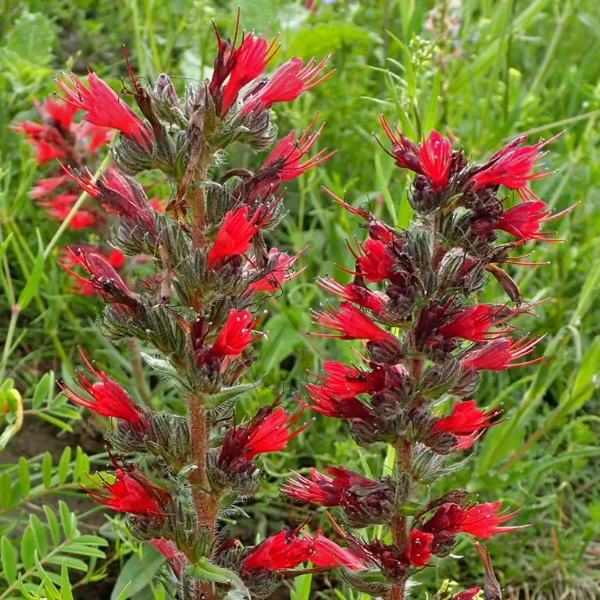
Echium russicum, also known as red-flowered viper’s grass, is a biennial or short-lived perennial that produces rosettes of silky-haired, greyish green leaves. The plant is known for its spikes of dark red, narrowly funnel-shaped flowers that are produced in late summer. It thrives in full sun and well-drained soil, making it suitable for various garden styles, including borders, meadows, and containers. Echium russicum is drought-tolerant once established and can be grown from seed or cuttings. It is also known to attract pollinators like bees and butterflies, making it an excellent choice for pollinator gardens.
plant lust.
Unlike the more commonly known blue-flowering species of Echium, Echium russicum offers an unusual display of vibrant red flowers that bloom during early to midsummer. Its architectural form, drought tolerance, and ability to attract beneficial insects have earned it growing popularity among gardeners seeking both beauty and biodiversity.
Appearance
Echium russicum forms a basal rosette of coarse, lance-shaped leaves covered in fine hairs. During its flowering season, sturdy upright stems emerge, reaching heights of approximately 60 to 100 cm. The dense flower spikes are packed with tubular crimson-red blossoms that gradually open from the base upwards, creating an impressive vertical display.
The flowers produce abundant nectar, making the plant a valuable food source for bees, butterflies, and other pollinating insects. Once flowering has finished, the seed heads develop an attractive texture that can also provide visual interest well into autumn.
Growing Conditions
Red Viper’s Bugloss performs best in full sun where it receives at least six hours of direct sunlight daily. It prefers well-drained, sandy or loamy soils and thrives in neutral to slightly alkaline conditions. Good drainage is essential, as excessively wet soils can lead to root problems, particularly during winter.
Once established, the plant demonstrates excellent drought tolerance and requires very little supplemental watering. It is well suited to low-maintenance gardens and can cope with periods of dry weather far better than consistently damp conditions.
Care and Maintenance
Echium russicum is a relatively easy plant to grow with minimal maintenance requirements. Regular watering is only necessary during its establishment period, after which watering should be limited to prolonged dry spells.
Removing spent flower spikes encourages a neat appearance and may reduce unwanted self-seeding. However, allowing some flower spikes to mature provides ornamental seed heads and offers food for wildlife. A light application of compost during spring is generally sufficient to support healthy growth without encouraging excessive foliage.
In colder regions, a layer of mulch around the base can help protect the crown during severe winter conditions while still allowing good drainage.
Landscaping Uses
The bold vertical habit of Echium russicum makes it an excellent feature plant in mixed perennial borders and naturalistic gardens. It pairs beautifully with ornamental grasses, salvias, lavender, yarrow, echinacea, and other sun-loving perennials.
Its vivid red flowers provide dramatic colour contrast against silver foliage plants and blue or purple flowering companions. It is equally effective when planted in groups, where the tall flower spikes create a spectacular midsummer display.
The dried flower spikes can also be incorporated into floral arrangements, adding texture and natural interest.
Wildlife Benefits
One of the greatest attractions of Echium russicum is its exceptional value to pollinators. The nectar-rich flowers attract honeybees, solitary bees, butterflies, hoverflies, and numerous other beneficial insects throughout its flowering period.
By supporting pollinator populations, the plant contributes to healthier garden ecosystems and improved pollination of nearby flowering plants and food crops. The seed heads may also provide seasonal interest for birds and other wildlife.
Interesting Facts
- The name Echium is derived from the Greek word for “viper,” referring to the shape of the seeds, which were once thought to resemble a snake’s head.
- Echium russicum is one of the few species within the genus to produce brilliant crimson-red flowers instead of the more familiar shades of blue.
- Mature plants are remarkably drought tolerant, making them ideal for water-wise and sustainable gardens.
- Its long flowering spikes make it an excellent choice for pollinator gardens and natural meadow-style plantings.
- The plant is highly attractive to bees and can become one of the busiest nectar sources in the garden during summer.
For sale in South Africa.
Shipping Countries: South Africa
Shipping States: Western Cape (South Africa)
Ready to ship in 1-3 business days
Shipping Policy
We will process your order within 1-3 business days.
Many of our plants can be couriered nationwide via the courier guy - and at checkout these options will be displayed. IF couriering doesn't come up as an option, this means that your basket contains one or more items that cannot be couriered - due to size/or practical reasons.
In this case, please either remove from your basket, or contact us for help.
For example, our horse compost cannot be sent via courier and will therefore appear as click and collect only!
We DO offer local deliveries! To those with postcode 7130. (or in the Raithby or Somerset West area.)
NB: We normally send the plants on a Monday or Tuesday to minimise the chance they'll get stuck in a depot over the weekend.
Refund Policy
No refunds on click & collect goods.
Normal refund policy (see terms and conditions) on other 'delivery' products.
| Weight | 0.7 kg |
|---|---|
| pot size cm | |
| colour | Red |
Product Location
Winery Rd, Raithby, South Africa-
Plants, Shrubs & Perennials
Abutilon megapotamicum
Raithby, WC
Bring a touch of charm and colour to your garden with Abutilon megapotamicum, also known as the Trailing or Chinese Lantern Abutilon. This graceful shrub produces a profusion of dangling, lantern-like flowers — bright yellow petals peeking from deep red calyces — from spring right through to autumn. Its blooms seem to dance among the leaves, attracting bees and butterflies with their nectar-rich appeal.
SKU: n/a -
Plants, Succulents & Cacti
Crassula capitella ‘Red Pagoda’
Raithby, WC
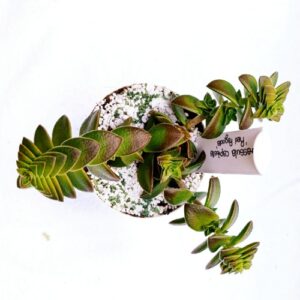
The Crassula capitella ‘Red Pagoda’ is a stunning branching succulent that sports a stack of fleshy, triangular chartreuse leaves that are adorned with red tips. It requires full sun to partial shade and well draining soil. It is ideal for rock gardens or planters. It is drought resistant and easy to maintain.
SKU: n/a

Related products
-
Plants, Shrubs & Perennials
Pleroma Urvilleana (Tibouchina)
Raithby, WC
This beautiful purple flowering evergreen plant grows into a graceful sprawling bush approximately 3-6m tall and 2-3m wide.
It has attractive dark green hairy leaves and clusters of dark purple flowers in Spring and Autumn. It likes gentle pruning once a year to keep it in shape. Partial shade and a sheltered position and medium water.
SKU: n/a -
Plants, Shrubs & Perennials
Euphorbia ‘Diamond Frost’
Raithby, WC
This lovely evergreen perennial has an extremely long flowering period, lasting from late-spring until the first frosts of autumn (if you get frosts).
It has tiny white delicate flowers continually through its flowering time.
It loves full sun or partial shade, in rich, moist and well drained soil. It can also be treated as an annual – compost it when it’s past its best.No deadheading is required either, and when temperatures rise, you’ll find it to be drought-tolerant.
Height: 45cmSpread: 30cm
Toxic to dogs/pets.
For sale in South Africa. Couriered nationwide.
SKU: n/a -