-
×
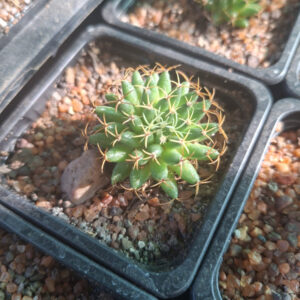 Mammillaria Camptotricha cv. Curlispina
- Vendor:
MantisPlants
Subtotal: R85.00


2 in stock
Astrophytum asterias Nudum is a rare, spineless cactus prized for its smooth, unmarked surface and distinctively round, button-like shape. Its green to bluish-grey body is divided into symmetrical segments, creating a minimalist yet captivating appearance. In spring, this unique cactus crowns itself with bright yellow flowers, often with a striking orange center, adding to its visual appeal. Native to the deserts of Mexico and Texas, Astrophytum asterias Nudum is a true collector’s gem, blending simplicity with elegance.
R60.00
2 in stock
Astrophytum asterias Nudum is ’n seldsame, stekellose kaktus wat bekend is vir sy gladde, ongemerkte oppervlak en kenmerkende ronde, knoppie-agtige vorm. Sy groen tot blouerige lyf is in simmetriese segmente verdeel, wat ’n minimalistiese maar fassinerende voorkoms skep. In die lente versier hierdie unieke kaktus homself met helder geel blomme, dikwels met ’n opvallende oranje middel, wat bydra tot sy visuele aantrekkingskrag. Inheems aan die woestyne van Mexiko en Texas, is Astrophytum asterias Nudum ’n ware versamelaarsjuweel wat eenvoud met elegansie kombineer.
Shipping States: Western Cape (South Africa), Free State (South Africa), North West (South Africa), Eastern Cape (South Africa), Northern Cape (South Africa), Mpumalanga (South Africa), Limpopo (South Africa), KwaZulu-Natal (South Africa), Gauteng (South Africa)
Ready to ship in 3-5 business days
Shipping Policy
**Shipping Policy for Plants**
At MantisPlants, we take great care in preparing and shipping your plants to ensure they arrive in the best possible condition.
Bare Root Shipping
All plants are typically shipped bare-rooted, meaning that the soil is carefully removed from the roots to prevent any damage during transit. We wash the roots to remove any remaining soil and allow them to dry before wrapping them gently in tissue paper. This process helps minimize stress on the plant and ensures its safe arrival to you.
Pot Shipping Option (Not Recommended)
While we do offer the option of shipping some plants in their pots, this is generally not advisable. Shipping a plant in its pot can result in root damage due to movement and stress during transit. The roots can become constricted or disturbed, which can harm the plant. If you are still interested in this option, it must be arranged in advance with the vendor, and we will take extra precautions to pack it as securely as possible. However, we highly recommend the bare-root shipping method to ensure the best possible outcome for your plant.
**Careful Packaging**
We take pride in our packing process to ensure your plant arrives safely. Every plant is carefully packed, with extra attention to detail to protect the roots and foliage. We take care to secure the plant during transit, and make sure it is cushioned and stabilized inside the shipping box to avoid damage.
Our goal is to make sure your plant reaches you healthy and ready to thrive! If you have any questions about the shipping process, feel free to reach out to us.
| Weight | 0.3 kg |
|---|---|
| pot size | 12cm |
S
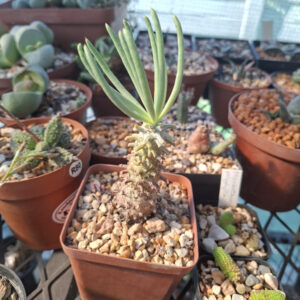
Description: Tylecodon Wallichii is a fascinating caudiciform succulent with thick, knotted stems and fleshy leaves that appear during its growing season. Its rugged appearance and seasonal growth habit make it a unique addition to any succulent or bonsai-style collection.
Origin: Native to the dry regions of South Africa and Namibia, where it grows in rocky, arid habitats.
Care:
This Haworthia hybrid is a small, succulent plant known for its distinctive rosettes of plump, fleshy leaves that can vary in shape, color, and texture, often featuring fascinating translucent or windowed tips. It’s ideal for indoor and outdoor growing in pots, and its compact size makes it a popular choice for succulent collectors.
Care Instructions:
Haworthia hybrids prefer bright, indirect sunlight and well-draining soil. Water sparingly, letting the soil dry out completely between waterings, especially in cooler months. Avoid direct, intense sunlight, which can burn the leaves, and protect from frost. A well-balanced cactus fertilizer can be used sparingly in the growing season.
Gymnocalycium mihanovichii is a small, globular cactus species native to the semi-arid regions of Paraguay and parts of northern Argentina. It belongs to the Cactaceae family and is part of a genus known for its relatively easy care, compact size, and attractive flowers.
This species typically grows to about 5–6 cm in height and 4–5 cm in diameter. It has a flattened, spherical body with 8–14 broad ribs and a grayish-green to dark green color. The stem is often slightly wrinkled and marked by low tubercles. It bears short, slightly curved spines that vary in number but are generally not aggressive, making the plant user-friendly for handling.
Flowers appear from the crown of the plant during late spring to summer. They are funnel-shaped and range in color from pale pink to light purple, occasionally white. The blooms are relatively large compared to the size of the plant and open during the day.
This species prefers well-draining cactus soil, moderate watering (allowing the soil to dry completely between waterings), and bright, indirect sunlight. Direct sun in hot climates can cause sunburn on the plant’s surface. It tolerates mild cold but should be protected from frost.
In cultivation, Gymnocalycium mihanovichii is often the parent of colorful grafted hybrids like the “Moon Cactus” (var. friedrichii), which lacks chlorophyll and must be grafted onto a host plant to survive.
Tulista pumila (formerly Haworthia pumila) is a striking and slow-growing succulent native to the Western Cape of South Africa. Known for its architectural beauty, this plant forms compact rosettes of thick, fleshy, dark green to brownish leaves covered with prominent raised white tubercles, giving it a textured, bumpy appearance.
Tulista pumila can grow up to 20 cm (8 inches) tall and wide, with mature plants producing tall, slender flower stalks bearing small, tubular, pale pink to white flowers—typically blooming in late spring to summer. The leaves are triangular and curved inward, often with toothed margins, adding to its ornamental value.
This species is drought-tolerant and prefers well-draining soil, partial sun to bright indirect light, and minimal watering—making it ideal for rock gardens, succulent collections, or container displays. Tulista pumila is also prized for its resilience and unique form, often regarded as one of the most attractive members of the Tulista genus.
A Euphorbia parvimedusae hybrid is a cultivated succulent variety developed by crossing Euphorbia parvimedusae—a rare and unusual species from South Africa—with another Euphorbia species, often to enhance certain traits such as size, growth habit, or ease of cultivation. These hybrids typically retain the unique, medusoid appearance of the parent species, characterized by a central caudex (swollen stem base) from which numerous cylindrical arms or branches radiate, resembling a sea anemone or the mythological head of Medusa.
Depending on the hybrid cross, the plant may show variations in:
Branch density – more compact or sprawling arms
Caudex shape – larger, more prominent, or more textured
Color – shades of green, grey-green, or even reddish tones
Spines – some hybrids may have more or fewer spines
Like most Euphorbias, these hybrids exude a white, toxic latex when damaged and should be handled with care. They prefer well-draining soil, minimal watering, and bright light—making them excellent candidates for collectors or enthusiasts interested in rare succulents.