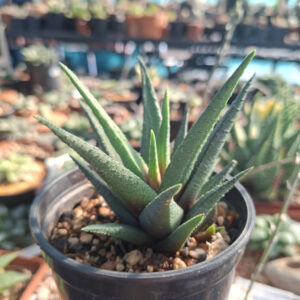
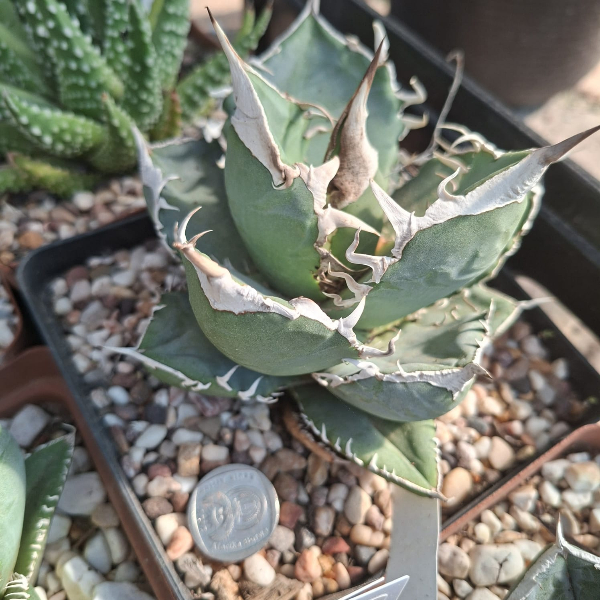
Agave titanota is a highly sought-after, slow-growing succulent in the Asparagaceae family, native to the semi-arid regions of Oaxaca, Mexico. Known for its striking, architectural form, this species features broad, thick, blue-gray to silvery-green leaves with prominent, dramatic teeth along the margins and a distinct terminal spine. The leaves often form a tight rosette, making it a favorite among collectors and landscape designers. It thrives in full sun and well-draining soil, and is highly drought-tolerant once established. Water sparingly, allowing the soil to dry out completely between waterings. Although hardy, Agave titanota should be protected from excessive cold and frost. With time, it may produce offsets around its base, and like all agaves, it flowers once at maturity—typically after many years—before dying back, leaving behind its offsets to continue the growth cycle.
- You cannot add that amount to the basket — we have 1 in stock and you already have 1 in your basket. View basket
Agave Titanota
4 in stock
Agave titanota is ’n baie gewilde, stadig-groeiende vetplant uit die Asparagaceae-familie en is inheems aan die semi-droë streke van Oaxaca, Meksiko. Hierdie spesie is bekend vir sy indrukwekkende, beeldhoukundige vorm en het breë, dik blare wat wissel van blougrys tot silwerig-groen, met opvallende, dramatiese tande langs die blaarrande en ’n kenmerkende eindsteek. Die blare vorm dikwels ’n digte roset, wat dit gewild maak onder versamelaars en landskapontwerpers. Dit groei die beste in volson en goed dreinerende grond, en is uiters droogtebestand sodra dit gevestig is. Water slegs wanneer die grond heeltemal droog is. Hoewel dit taai is, moet Agave titanota teen uiterste koue en ryp beskerm word. Met verloop van tyd kan dit uitlopers rondom die basis vorm, en soos alle agaves blom dit slegs een keer in sy leeftyd—gewoonlik ná baie jare—en sterf daarna af, maar laat ’n nuwe generasie agter deur die uitlopers.
R250.00 R400.00
4 in stock
Ready to ship in 3-5 business days
Shipping Policy
**Shipping Policy for Plants**
At MantisPlants, we take great care in preparing and shipping your plants to ensure they arrive in the best possible condition.
Bare Root Shipping
All plants are typically shipped bare-rooted, meaning that the soil is carefully removed from the roots to prevent any damage during transit. We wash the roots to remove any remaining soil and allow them to dry before wrapping them gently in tissue paper. This process helps minimize stress on the plant and ensures its safe arrival to you.
Pot Shipping Option (Not Recommended)
While we do offer the option of shipping some plants in their pots, this is generally not advisable. Shipping a plant in its pot can result in root damage due to movement and stress during transit. The roots can become constricted or disturbed, which can harm the plant. If you are still interested in this option, it must be arranged in advance with the vendor, and we will take extra precautions to pack it as securely as possible. However, we highly recommend the bare-root shipping method to ensure the best possible outcome for your plant.
**Careful Packaging**
We take pride in our packing process to ensure your plant arrives safely. Every plant is carefully packed, with extra attention to detail to protect the roots and foliage. We take care to secure the plant during transit, and make sure it is cushioned and stabilized inside the shipping box to avoid damage.
Our goal is to make sure your plant reaches you healthy and ready to thrive! If you have any questions about the shipping process, feel free to reach out to us.
| Weight | 0.3 kg |
|---|---|
| pot size | 7.5cm |
Based on 0 reviews
Only logged in customers who have purchased this product may leave a review.
Product Location
oudthoorn, South Africa-
-
Plants, Succulents & Cacti
Aloe cv Pearl Necklace
Oudtshoorn, WC
Aloe ‘Pearl Necklace’ (also sometimes sold under names like ‘Sal’) is a visually striking Aloe hybrid prized for its spotted leaves and compact rosette form. Its most notable feature is the dense pattern of pale, pearl-like spots scattered across each leaf, giving a beaded appearance—hence the name.
It typically grows as:
-
A compact, symmetric rosette
-
Leaves tapering to fine tips with minimal or barely visible marginal teeth
-
Light green to grey-green foliage, with the white spotting intensifying under bright sun or during periods of mild stress
SKU: n/a -
-
Plants, Succulents & Cacti
Copiapoa Hypogaea cv. Lizard Skin
Oudtshoorn, WC
The Copiapoa hypogaea cv. Lizard Skin is a rare and unique cultivar native to the arid regions of northern Chile. Its textured, reptilian-like surface sets it apart as a true collector’s gem. Compact and slow-growing, this succulent thrives in well-drained soil and bright sunlight, making it a must-have for cacti enthusiasts. With its limited availability and striking appearance, the “Lizard Skin” cultivar adds both intrigue and exclusivity to any collection. Don’t miss the opportunity to own this fascinating specimen!
SKU: n/a -
Plants, Succulents & Cacti
Gymnocalycium mihanovichii Hybrids
Oudtshoorn, WC
Gymnocalycium mihanovichii is a small, globular cactus species native to the semi-arid regions of Paraguay and parts of northern Argentina. It belongs to the Cactaceae family and is part of a genus known for its relatively easy care, compact size, and attractive flowers.
This species typically grows to about 5–6 cm in height and 4–5 cm in diameter. It has a flattened, spherical body with 8–14 broad ribs and a grayish-green to dark green color. The stem is often slightly wrinkled and marked by low tubercles. It bears short, slightly curved spines that vary in number but are generally not aggressive, making the plant user-friendly for handling.
Flowers appear from the crown of the plant during late spring to summer. They are funnel-shaped and range in color from pale pink to light purple, occasionally white. The blooms are relatively large compared to the size of the plant and open during the day.
This species prefers well-draining cactus soil, moderate watering (allowing the soil to dry completely between waterings), and bright, indirect sunlight. Direct sun in hot climates can cause sunburn on the plant’s surface. It tolerates mild cold but should be protected from frost.
In cultivation, Gymnocalycium mihanovichii is often the parent of colorful grafted hybrids like the “Moon Cactus” (var. friedrichii), which lacks chlorophyll and must be grafted onto a host plant to survive.
SKU: n/a
Crassula ovata "Gollum"
Tulista Pumila, Haworthia Pumila
Haworthia Sordida Hybrid
Copiapoa Hypogaea cv. Lizard Skin
Astrophytum Myriostigma Tricostatum
Haworthia Viscosa Hybrid

There are no reviews yet.