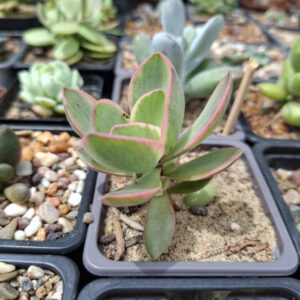
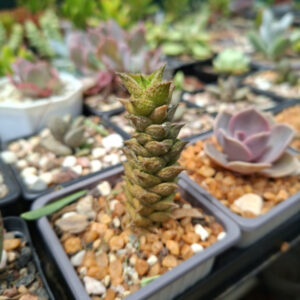
Euphorbia pulvinata is ‘n klein, kussingvormige vetplant wat inheems is aan Suid-Afrika. Dit vorm digte, afgeronde trosse wat soos groen kussinkies lyk – wat die naam “pulvinata,” wat “kussingagtig” beteken, weerspieël. Die plant het kort, dik stingels met klein knoppies en dorings wat dit ‘n growwe tekstuur gee. In die lente tot vroeë somer dra dit klein geelgroen blommetjies (cyathia) aan die punte van sy stingels. Soos ander Euphorbia-spesies, bevat dit ‘n melkerige sap wat vel kan irriteer en giftig is as dit ingeneem word. Dit groei die beste in volle son met goed dreinerende grond en is ideaal vir rotstuine, potte of vetplantversamelings.
Plants, Succulents & Cacti
Euphorbia Pulvinata (Meloformis Variegated)
Availability:
3 in stock
Euphorbia pulvinata is a small, cushion-forming succulent native to South Africa. It grows in dense, rounded clumps that resemble little green pillows, hence the name “pulvinata,” which means “cushion-like.” This plant has short, thick stems covered in small tubercles and spines, giving it a textured appearance. In spring to early summer, it produces tiny, yellow-green flowers (cyathia) at the tips of its stems. Like most euphorbias, it contains a milky sap that can be irritating to the skin and toxic if ingested. It thrives in full sun with well-draining soil and is ideal for rock gardens, containers, or succulent collections.
R320.00
3 in stock
Shipping States: Mpumalanga (South Africa), Limpopo (South Africa), KwaZulu-Natal (South Africa), Gauteng (South Africa), Western Cape (South Africa), Free State (South Africa), North West (South Africa), Eastern Cape (South Africa), Northern Cape (South Africa)
Ready to ship in 3-5 business days
Shipping Policy
**Shipping Policy for Plants**
At MantisPlants, we take great care in preparing and shipping your plants to ensure they arrive in the best possible condition.
Bare Root Shipping
All plants are typically shipped bare-rooted, meaning that the soil is carefully removed from the roots to prevent any damage during transit. We wash the roots to remove any remaining soil and allow them to dry before wrapping them gently in tissue paper. This process helps minimize stress on the plant and ensures its safe arrival to you.
Pot Shipping Option (Not Recommended)
While we do offer the option of shipping some plants in their pots, this is generally not advisable. Shipping a plant in its pot can result in root damage due to movement and stress during transit. The roots can become constricted or disturbed, which can harm the plant. If you are still interested in this option, it must be arranged in advance with the vendor, and we will take extra precautions to pack it as securely as possible. However, we highly recommend the bare-root shipping method to ensure the best possible outcome for your plant.
**Careful Packaging**
We take pride in our packing process to ensure your plant arrives safely. Every plant is carefully packed, with extra attention to detail to protect the roots and foliage. We take care to secure the plant during transit, and make sure it is cushioned and stabilized inside the shipping box to avoid damage.
Our goal is to make sure your plant reaches you healthy and ready to thrive! If you have any questions about the shipping process, feel free to reach out to us.
Based on 0 reviews
Only logged in customers who have purchased this product may leave a review.
Product Location
oudthoorn, South Africa-
Plants, Succulents & Cacti
Astrophytum Myriostigma Tricostatum
Oudtshoorn, WC
Astrophytum Myriostigma var. quadricostatum, also known as the “Bishop’s Cap Cactus,” is a distinctive, spineless cactus with four prominent ribs, giving it a star-shaped appearance. Native to Mexico, this cactus is covered with tiny white dots that help it retain water in dry climates. It’s a great choice for collectors due to its unique look and easy care.
Care Instructions:
- Light: Prefers bright, indirect sunlight; a few hours of direct morning sun is beneficial.
- Water: Water sparingly, especially during winter. Allow the soil to dry completely between waterings to prevent rot.
- Soil: Use a well-draining cactus soil mix, ideally with added grit or sand.
- Temperature: Thrives in warm conditions (20-30°C) but can tolerate cooler temperatures down to around 5°C if kept dry.
- Humidity: Low humidity is best.
- Fertilizer: Apply a diluted cactus fertilizer during the growing season (spring and summer).
SKU: n/a -
Plants, Succulents & Cacti
Crassula Ovata
Oudtshoorn, WC
Crassula ovata, commonly known as the Jade Plant, is a popular succulent native to South Africa. It has thick, glossy, oval-shaped leaves that are usually green but can develop a reddish tinge at the edges when exposed to sunlight. This hardy plant is known for its resilience and can grow as a small shrub or small tree. It blooms with small, star-shaped white or pink flowers in late winter or early spring. Crassula ovata is often kept as an ornamental houseplant and is associated with good luck and prosperity in some cultures.
SKU: n/a -
Plants, Succulents & Cacti
Aloe cv Pearl Necklace
Oudtshoorn, WC
Aloe ‘Pearl Necklace’ (also sometimes sold under names like ‘Sal’) is a visually striking Aloe hybrid prized for its spotted leaves and compact rosette form. Its most notable feature is the dense pattern of pale, pearl-like spots scattered across each leaf, giving a beaded appearance—hence the name.
It typically grows as:
-
A compact, symmetric rosette
-
Leaves tapering to fine tips with minimal or barely visible marginal teeth
-
Light green to grey-green foliage, with the white spotting intensifying under bright sun or during periods of mild stress
SKU: n/a -
-
Plants, Succulents & Cacti
Astrophytum Myriostigma Tricostatum
Oudtshoorn, WC
Astrophytum myriostigma var. tricostatum is a rare and visually striking variety of the Bishop’s Cap cactus, native to Mexico. Unlike the typical five-ribbed form, this variety usually has only three prominent ribs (hence “tricostatum”). It has a smooth, spineless surface covered with tiny white speckles that give it a starry appearance. The cactus produces yellow, daisy-like flowers at the top during spring or summer. Due to its unique shape and low-maintenance care needs, it is highly sought after by collectors and succulent enthusiasts.
SKU: n/a -
Plants, Succulents & Cacti
Euphorbia parvimedusae hybrid
Oudtshoorn, WC
A Euphorbia parvimedusae hybrid is a cultivated succulent variety developed by crossing Euphorbia parvimedusae—a rare and unusual species from South Africa—with another Euphorbia species, often to enhance certain traits such as size, growth habit, or ease of cultivation. These hybrids typically retain the unique, medusoid appearance of the parent species, characterized by a central caudex (swollen stem base) from which numerous cylindrical arms or branches radiate, resembling a sea anemone or the mythological head of Medusa.
Depending on the hybrid cross, the plant may show variations in:
-
Branch density – more compact or sprawling arms
-
Caudex shape – larger, more prominent, or more textured
-
Color – shades of green, grey-green, or even reddish tones
-
Spines – some hybrids may have more or fewer spines
Like most Euphorbias, these hybrids exude a white, toxic latex when damaged and should be handled with care. They prefer well-draining soil, minimal watering, and bright light—making them excellent candidates for collectors or enthusiasts interested in rare succulents.
SKU: n/a -
-
Plants, Succulents & Cacti
Tulista Pumila, Haworthia Pumila
Oudtshoorn, WC
Tulista pumila (formerly Haworthia pumila) is a striking and slow-growing succulent native to the Western Cape of South Africa. Known for its architectural beauty, this plant forms compact rosettes of thick, fleshy, dark green to brownish leaves covered with prominent raised white tubercles, giving it a textured, bumpy appearance.
Tulista pumila can grow up to 20 cm (8 inches) tall and wide, with mature plants producing tall, slender flower stalks bearing small, tubular, pale pink to white flowers—typically blooming in late spring to summer. The leaves are triangular and curved inward, often with toothed margins, adding to its ornamental value.
This species is drought-tolerant and prefers well-draining soil, partial sun to bright indirect light, and minimal watering—making it ideal for rock gardens, succulent collections, or container displays. Tulista pumila is also prized for its resilience and unique form, often regarded as one of the most attractive members of the Tulista genus.
SKU: n/a
Garden Tool Belt
Crassula swaziensis Variegated
Mulberry leaves (pack of 10)
Coryphantha Elephantidens Inermis
Euphorbia Debilispina
36cm African Bush Bird Bath
Astroloba Corrugata


There are no reviews yet.