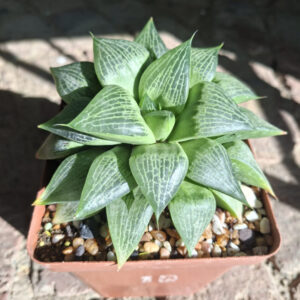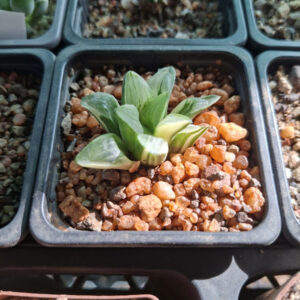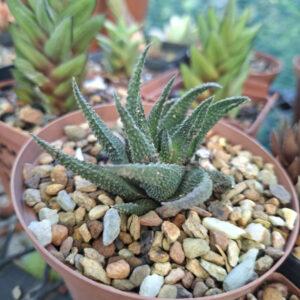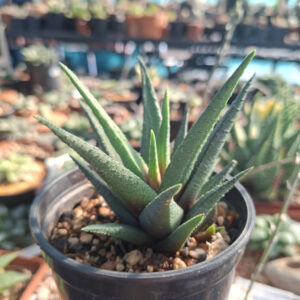


Plants
Showing 97–144 of 342 results
-
Plants, Succulents & Cacti
Euphorbia suzannae
Oudtshoorn, WC
Euphorbia suzannae is a distinctive succulent belonging to the Euphorbiaceae family. Native to the Cape region of South Africa, it grows as a small, rounded plant with fleshy green stems that may develop reddish tones in bright sunlight. It typically reaches up to 30 cm tall and produces clusters of tiny lance-shaped leaves at the tips of its stems, creating a charming contrast against its thick body. In favorable conditions, it may produce small yellow-green flowers.
This species thrives in well-draining soil, requires moderate watering (allow soil to dry between waterings), and should be protected from frost. Like many Euphorbias, it contains toxic latex sap, so handle with care and keep away from pets and children. Its compact size and resilience make it an excellent choice for collectors and drought-tolerant gardens
SKU: n/a -
Plants, Succulents & Cacti
Gasteria Batesiana
Oudtshoorn, WC
Gasteria batesiana is a small, hardy succulent native to South Africa. It has dark green, triangular leaves with rough, textured surfaces, often adorned with white spots or streaks. The plant grows in a rosette form and can tolerate low light, making it ideal for indoor cultivation. It produces tubular, pinkish-red flowers on tall stalks, typically during the spring or summer. Known for its drought tolerance and easy care, Gasteria batesiana is popular among succulent collectors.
SKU: n/a -
Plants, Succulents & Cacti
Gasteria Batesiana
Oudtshoorn, WC
Gasteria Batesiana, a striking succulent native to the rocky terrains of South Africa, is a must-have for any plant enthusiast. With its thick, glossy, dark green leaves adorned with pale white spots, it adds a touch of the exotic to any collection. This hardy plant thrives in well-draining soil and enjoys bright, indirect light. Minimal watering is required, making it perfect for low-maintenance care. Its unique appearance and resilience make Gasteria Batesiana a captivating addition to both indoor and outdoor gardens.
SKU: n/a -
Plants, Succulents & Cacti
Gasteria Ellaphieae
Oudtshoorn, WC
Gasteria ellaphieae is ’n kompakte, stadig-groeiende vetplant wat inheems is aan Suid-Afrika, spesifiek die Oos-Kaap. Dit behoort aan die Asphodelaceae-familie en is vernoem na die bekende plantillustreerder Ellaphie Ward-Hilhorst. Die plant word gekenmerk deur sy digte, vlesige blare wat in ’n waaierpatroon (distig) gerangskik is. Die blare is donkergroen met ligte of wit kolle, en volwasse plante dra buisvormige pienk-rooi blommetjies op dun stingels in die laat winter tot lente. Gasteria ellaphieae verkies helder, indirekte lig en goed dreinerende grond. Dit is droogtebestand en moet slegs natgemaak word wanneer die grond heeltemal droog is. Hierdie spesie is ideaal vir potte of rotstuine, maar moet beskerm word teen ryp en oormatige vog. Voortplanting geskied maklik via blaarstekke of sytakke (uitlopers).
SKU: n/a -
Plants, Succulents & Cacti
Gasteria Glomerata
Oudtshoorn, WC
Gasteria glomerata is a compact, slow-growing succulent native to the Eastern Cape province of South Africa. It forms small, dense clusters of short, tongue-shaped leaves that are smooth, grey-green, and often speckled with white. The leaves grow in pairs, forming a neat fan shape.
In spring, it produces slender flower stalks with tubular, two-toned pink and greenish flowers, typical of the Gasteria genus. Gasteria glomerata thrives in bright, indirect light, well-draining soil, and infrequent watering—making it an ideal choice for indoor succulent collections.
SKU: n/a -
Plants, Succulents & Cacti
Gasteria Lilliputana
Oudtshoorn, WC
Gasteria lilliputana is a tiny, yet striking succulent native to South Africa. This miniature plant features thick, fleshy leaves that form a dense rosette, with dark green to greyish-green coloring and distinctive white markings or spots. The leaves are rough to the touch, giving it a unique texture that stands out in succulent collections. In late winter or early spring, it produces small, tubular flowers in shades of pink or red, adding a pop of color to its compact form. Interesting fact: Despite its small size, Gasteria lilliputana is extremely hardy and can tolerate drought and neglect, making it an ideal choice for beginner succulent growers. Its slow-growing nature also means it requires minimal maintenance and thrives in bright, indirect light.
SKU: n/a -
Plants, Succulents & Cacti
Gymnocalycium friedrichii variegated
Oudtshoorn, WC
Gymnocalycium friedrichii variegated is a stunning cactus with unique, striped patterns of red, yellow, and green, making it a true standout in any collection. Interesting Fact: This variety is rare and highly sought after due to its vibrant colors and its ability to thrive in both bright and indirect light conditions.
SKU: 1-1-1-1-1-1 -
Plants, Succulents & Cacti
Gymnocalycium mihanovichii Hybrids
Oudtshoorn, WC
Gymnocalycium mihanovichii is a small, globular cactus species native to the semi-arid regions of Paraguay and parts of northern Argentina. It belongs to the Cactaceae family and is part of a genus known for its relatively easy care, compact size, and attractive flowers.
This species typically grows to about 5–6 cm in height and 4–5 cm in diameter. It has a flattened, spherical body with 8–14 broad ribs and a grayish-green to dark green color. The stem is often slightly wrinkled and marked by low tubercles. It bears short, slightly curved spines that vary in number but are generally not aggressive, making the plant user-friendly for handling.
Flowers appear from the crown of the plant during late spring to summer. They are funnel-shaped and range in color from pale pink to light purple, occasionally white. The blooms are relatively large compared to the size of the plant and open during the day.
This species prefers well-draining cactus soil, moderate watering (allowing the soil to dry completely between waterings), and bright, indirect sunlight. Direct sun in hot climates can cause sunburn on the plant’s surface. It tolerates mild cold but should be protected from frost.
In cultivation, Gymnocalycium mihanovichii is often the parent of colorful grafted hybrids like the “Moon Cactus” (var. friedrichii), which lacks chlorophyll and must be grafted onto a host plant to survive.
SKU: n/a -
Plants, Succulents & Cacti
Gymnocalycium mihanovichii variegata
Oudtshoorn, WC
Gymnocalycium mihanovichii variegata, commonly known as the Variegated Moon Cactus, is a striking and unique cactus characterized by its vibrant, multicolored tops, which are often bright yellow, pink, or red. The colorful crown is a result of a lack of chlorophyll, making it an interesting addition to any succulent collection. The base of the cactus is typically a green Gymnocalycium, which provides stability and nutrients to the colorful top. This plant is often grafted onto a more resilient cactus species to enhance its growth and longevity.
Care Instructions:
- Light: Requires bright, indirect sunlight. Avoid direct sunlight to prevent scorching the colorful tops.
- Water: Water sparingly, allowing the soil to dry out completely between waterings. During the growing season (spring and summer), water more frequently, but reduce watering in fall and winter.
- Soil: Use a well-draining cactus mix to prevent root rot.
- Temperature: Thrives in warm conditions, ideally between 18-30°C (65-86°F). Protect from frost and cold drafts.
SKU: n/a -
-
Plants, Succulents & Cacti
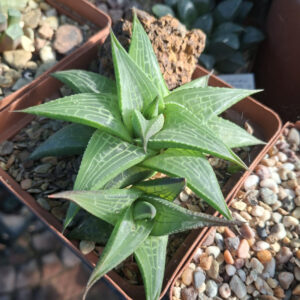
Haworthia Comptoniana
Oudtshoorn, WC
Description: Haworthia Comptoniana is a beautiful and collectible succulent known for its broad, translucent leaves with intricate vein patterns. The glossy “windowed” leaves create a striking appearance, making it a favourite among Haworthia collectors.
Origin: Native to the Eastern Cape region of South Africa, where it grows in rocky, semi-arid environments.
Care:
- Light: Bright indirect light or light shade
- Water: Water thoroughly and allow soil to dry between waterings
- Soil: Well-draining succulent or cactus mix
- Temperature: Protect from frost and excessive cold
- Growth: Slow-growing and ideal for pots, windowsills, and indoor collections
SKU: n/a -
Plants, Succulents & Cacti
Haworthia Emelyae, Witkliprug Specimen Plant
Oudtshoorn, WC
Haworthia emelyae is a small, succulent plant native to South Africa, known for its striking rosettes of thick, triangular leaves. The leaves are often green with translucent tips and may have white speckles or ridges. This slow-growing species thrives in well-draining soil and prefers partial shade, making it a popular choice for succulent enthusiasts. It produces delicate white flowers on slender stalks.
SKU: 1-1-2-1-2-1-2-1 -
Plants, Succulents & Cacti
Haworthia Nigra
Oudtshoorn, WC
Haworthia nigra is a little succulent with a big attitude! With its dark, almost black, spiky leaves stacked in tight layers, it looks like it’s ready to join the goth plant club. Native to South Africa, this hardy little character doesn’t need much to thrive but always stands out with its unique look. Perfect for those who appreciate a plant that can rock the “all black everything” vibe!
Care Instructions:
Haworthia nigra prefers bright, indirect light but can tolerate some shade. Plant it in well-draining soil and water sparingly, letting the soil dry out completely between waterings. It grows slowly and enjoys a light monthly feeding of diluted succulent fertilizer during the warmer months. Just remember: too much water makes it sulky!SKU: n/a -
Plants, Succulents & Cacti
Haworthia Retusa Variegated
Oudtshoorn, WC
Haworthia retusa Variegated is a stunning and highly collectible succulent admired for its translucent leaf windows and beautiful cream, yellow, and green variegation. Its thick fleshy leaves form compact rosettes with a geometric appearance that makes each plant a living piece of art. The transparent leaf tips allow sunlight to penetrate deep into the plant, helping it survive in harsh conditions. This slow-growing succulent thrives in bright indirect light, well-draining soil, and careful watering.
Interesting Fact:
The transparent “windows” on the leaves of Haworthia retusa allow light to reach inner tissues even when the plant is partially buried in soil or sand in its natural habitat.Original Habitat:
Native to the Western Cape Province of South Africa, where it grows in rocky semi-arid areas, often partially hidden among stones and low vegetation.SKU: n/a -
Plants, Succulents & Cacti
Haworthia Scabra var Scabra
Oudtshoorn, WC
Haworthia scabra var. scabra
A tough yet beautifully textured succulent, Haworthia scabra var. scabra is known for its elongated rosettes of firm, dark green leaves covered in rough, sandpaper-like ridges. Its rugged surface and upright growth give it a distinctive, hardy appearance that contrasts nicely with smoother succulents in any collection.
This resilient species is well-suited to a variety of conditions, thriving in bright, indirect light with minimal watering. Its durability and unique texture make it an excellent choice for both beginners and collectors.
Interesting fact:
The name “scabra” means “rough” or “scaly,” referring to the plant’s coarse leaf texture—an adaptation that helps reduce water loss in its natural habitat.SKU: n/a -
Plants, Succulents & Cacti
Haworthia Sordida Hybrid
Oudtshoorn, WC
Haworthia Sordida Hybrid is a rare and attractive succulent with compact rosettes and beautifully textured leaves. Its unique patterns and hardy nature make it a perfect choice for collectors and small pot displays. Easy to care for and ideal for bright, indirect light.
SKU: n/a -
Plants, Succulents & Cacti
Haworthia Tessellata
Oudtshoorn, WC
Haworthia tessellata is a small, slow-growing succulent native to southern Africa. It is known for its distinctive, thick, triangular leaves that form a rosette. The leaves are dark green to brownish and feature a unique, tessellated (checkerboard-like) pattern on their surface, which gives the plant its name. This pattern helps it blend into its natural rocky surroundings. Haworthia tessellata prefers indirect light and well-draining soil, making it an excellent and easy-to-care-for houseplant.
SKU: n/a -
Plants, Succulents & Cacti
Haworthia Tessellata
Oudtshoorn, WC
Origin: Haworthia Tessellata is native to the arid regions of South Africa and Namibia, where it grows in rocky soils and partial shade.
Care:
- Light: Bright indirect light or partial shade
- Water: Water thoroughly, then allow soil to dry out completely
- Soil: Well-draining cactus or succulent mix
- Temperature: Protect from frost and extreme cold
- Growth: Compact and slow-growing, ideal for small pots and indoor displays
SKU: n/a -
Plants, Succulents & Cacti
Haworthia Truncata
Oudtshoorn, WC
Haworthia truncata is a distinctive, slow-growing succulent native to the Little Karoo region of South Africa. It is best known for its unusual “horse-tooth” leaf arrangement, where the leaf tips appear as flat, truncated windows sticking out of the soil.
Characteristics:
- Grows in small clusters of thick, rectangular leaves arranged in two opposite rows (distichous pattern).
- Leaf tips are flat and translucent, allowing light to enter the buried plant body.
- Usually grey-green to brown-green in colour, often blending with surrounding soil.
- Remains mostly underground in habitat, with only leaf tips exposed.
- Produces small white to pale pink flowers on slender stalks, usually in spring.
Cultivation:
- Winter-growing species (active in cooler months).
- Requires very well-drained, mineral-rich soil.
- Water sparingly during active growth; reduce watering in summer dormancy.
- Prefers bright light but can tolerate partial shade.
- Sensitive to overwatering, especially in cool conditions.
Habitat:
- Native to rocky, semi-desert areas of the Little Karoo, South Africa.
- Often grows partially buried among quartz or clay soils.
SKU: n/a -
Plants, Succulents & Cacti
Haworthia Viscosa Calitzdorp
Oudtshoorn, WC
Haworthia viscosa ‘Calitzdorp’ is a striking succulent known for its compact, triangular leaves arranged in elegant vertical stacks. Native to South Africa, this rare variety features thick, dark green leaves with a smooth, glossy surface, giving it a sculptural, geometric form. Its architectural beauty makes it a standout in any collection, and its slow-growing nature only enhances its appeal. Perfect for collectors of rare succulents, Haworthia viscosa ‘Calitzdorp’ is a symbol of understated elegance and natural resilience.
SKU: n/a -
Plants, Succulents & Cacti
Haworthia Viscosa Hybrid
Oudtshoorn, WC
This Haworthia hybrid is a small, succulent plant known for its distinctive rosettes of plump, fleshy leaves that can vary in shape, color, and texture, often featuring fascinating translucent or windowed tips. It’s ideal for indoor and outdoor growing in pots, and its compact size makes it a popular choice for succulent collectors.
Care Instructions:
Haworthia hybrids prefer bright, indirect sunlight and well-draining soil. Water sparingly, letting the soil dry out completely between waterings, especially in cooler months. Avoid direct, intense sunlight, which can burn the leaves, and protect from frost. A well-balanced cactus fertilizer can be used sparingly in the growing season.SKU: n/a -
Plants, Succulents & Cacti
Haworthia Viscosa Hybrid
Oudtshoorn, WC
The Haworthia Viscosa Hybrid is a unique succulent known for its compact, triangular leaves arranged in a striking spiral pattern. This hybrid originates from the Haworthia viscosa, a species native to South Africa. It thrives in well-draining soil, requires bright but indirect sunlight, and should be watered sparingly to prevent root rot. Ideal for indoor or outdoor cultivation in mild climates, it is a low-maintenance plant that adds architectural interest to any collection.
SKU: n/a -
Hydrangeas, Plants, Shrubs & Perennials
Hydrangea (variegated)
Raithby, WC
Hydrangea variegated
Beautiful white and green leaved hydrangea. Also known as a Christmas Rose in South Africa. Or hortensia for Europeans.
Deciduous, flowers Nov-Mar (eventual height approx 90cm).
The flowers are excellent for cutting.
Half sun or shade.
Pink delicate flowers.SKU: n/a -
Plants, Shrubs & Perennials
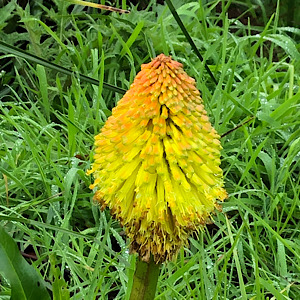
Kniphofia (Red Hot Poker)
Raithby, WC
Kniphofia (Red Hot Poker)
These stately plants make a striking statement in the garden during winter, with their tall and colourful spires.
A very hardy herbaceous perennial, it has long strap like leaves. They multiply easily and form clumps.
SKU: n/a -
Plants, Succulents & Cacti
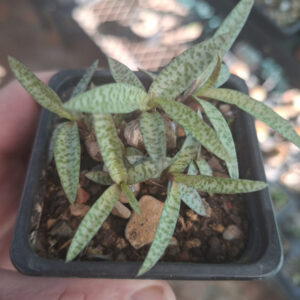
Ledebouria Socialis Miniature
Oudtshoorn, WC
Ledebouria socialis ‘Miniature’ is a charming dwarf succulent bulb plant loved for its compact size and beautifully spotted silver-green leaves with deep purple undersides. This miniature variety forms dense clusters over time, making it perfect for small pots, windowsills, fairy gardens, or collectors of unusual succulents. During the growing season, it produces delicate greenish flowers on slender stems that add extra character to the plant. It thrives in bright indirect light, well-draining soil, and moderate watering.
Interesting Fact:
Ledebouria socialis is commonly known as the “Silver Squill,” and its spotted leaves help camouflage the plant among rocks and dry ground in its natural habitat.Original Habitat:
Native to the Eastern Cape Province of South Africa, where it grows in rocky areas and dry woodland environments.
The “Booby Cactus” mutation is a natural genetic growth irregularity called a monstrose form, meaning no two plants grow exactly the same.
Original Habitat:
Originally native to central and northern Mexico, where the normal species grows in dry rocky deserts and semi-arid regions.SKU: n/a -
Plants, Succulents & Cacti
Lithops Optica Rubra
Oudtshoorn, WC
Description: Lithops Optica Rubra is a rare and eye-catching “living stone” succulent prized for its striking pink to reddish-purple colour. Its compact shape and unusual appearance make it a favourite among Lithops collectors and succulent enthusiasts.
Origin: Native to the arid regions of Namibia and South Africa, where it grows partially buried among stones for camouflage and protection from harsh sunlight.
Care:
- Light: Bright light to full sun
- Water: Water very sparingly; allow soil to dry completely between waterings
- Soil: Extremely well-draining mineral or Lithops mix
- Temperature: Protect from frost and excessive moisture
- Growth: Slow-growing and ideal for small pots and collector display
SKU: n/a -
Plants, Succulents & Cacti
Mammallaria Theresae
Oudtshoorn, WC
Mammillaria theresae is a miniature, rare cactus native to the mountainous regions of Durango, Mexico. It features soft, white spines and vibrant pink to magenta flowers that bloom in spring. This slow-growing species prefers bright light, well-draining soil, and minimal watering. A true gem for collectors!
SKU: n/a -
Plants, Succulents & Cacti
Mammillaria Camptotricha cv. Curlispina
Oudtshoorn, WC
Mammillaria Camptotricha cv. Curlispina is a rare and highly sought-after cactus admired for its unusual curled white spines that resemble tangled ribbons or soft wool. This compact species forms small clusters and creates a striking display in any succulent or cactus collection. During flowering season, it produces delicate creamy-white to pale yellow flowers that beautifully contrast with its twisted spines. It thrives in bright light, well-draining soil, and careful watering.
Interesting Fact:
The name “Curlispina” literally refers to its curly spines, which help reflect intense sunlight in its natural environment and protect the plant from excessive heat.Original Habitat:
Originally native to the dry limestone regions of central Mexico, especially in areas with arid conditions and rocky terrain.SKU: n/a -
Plants, Succulents & Cacti
Mammillaria Decipiens, Birds Nest Cactus
Oudtshoorn, WC
Mammillaria decipiens (Bird’s Nest Cactus)
A charming and compact cactus, Mammillaria decipiens forms dense clusters of soft, cylindrical stems that naturally arrange into a beautiful “bird’s nest” shape. Its fine, radial spines give it a delicate, textured look, while in season it produces a ring of small, creamy-white to pale yellow flowers that crown each stem like a halo.
Perfect for small pots or collectors’ displays, this easy-care species thrives in bright light and requires minimal watering, making it ideal for both beginners and seasoned cactus enthusiasts.
Interesting fact:
The name “decipiens” means “deceptive” — a nod to how this cactus can easily be mistaken for other Mammillaria species, even by experienced collectors.SKU: n/a -
Plants, Succulents & Cacti
Mammillaria Luethyi
Oudtshoorn, WC
Mammillaria luethyi is a small, spherical cactus native to Mexico, known for its attractive clusters of white spines and vibrant pink flowers. This species typically grows in rocky or arid environments and is highly sought after by collectors due to its compact size and ornamental beauty.
SKU: 1-1-2-1-2-1-2 -
Plants, Succulents & Cacti
Mammillaria Theresea
Oudtshoorn, WC
Mammillaria theresae is a rare and highly sought-after miniature cactus native to the rocky slopes of Durango, Mexico. It is known for its compact size, dense white spines, and stunning pink to magenta flowers that bloom in spring. This slow-growing species thrives in well-draining soil, bright indirect sunlight, and minimal watering. To prevent root rot, allow the soil to dry completely between waterings. Mammillaria theresae prefers warm temperatures and should be protected from frost.
SKU: n/a -
Herbs, Plants
Mentha spicata (Spearmint)
Mossèlbay, WC
Aromatic herb with erect, square-shaped stems and narrow, oval-shaped leaves that have pointed tips and toothed edges.
How it grows: It prefers part shade and moist soil with a neutral to slightly acidic ph.
When it fruits: Flowers in the summer from July to Sept and has large seeds.
Edible: It is not only tasty but may also be good for you.
Weight: One ounce is a little over 28 grams. Steep 1 teaspoon in 8 ounces of water for 5 minutes to make spearmint tea.SKU: n/a -
-
Plants, Succulents & Cacti
Obregonia Denegrii
Oudtshoorn, WC
: Obregonia denegrii, also known as the Artichoke Cactus, is a rare, slow-growing cactus native to northeastern Mexico. It has a unique, spiral rosette resembling an artichoke. For optimal growth, plant it in well-draining cactus soil and place it in a spot with full sun to partial shade. Water sparingly, allowing the soil to dry completely between waterings, especially in winter. An interesting fact about Obregonia denegrii is that it is the only species in its genus, making it a distinct and prized specimen among cactus enthusiasts.
SKU: n/a -
Plants, Shrubs & Perennials
Odoratissimus (Pelargonium)
Mossèlbay, WC
Description: A free flowering pelargonium with a compact and bushy habit and pink flowers. Ideal for pots and containers.
How it grows: Pelargoniums are sun loving plants, but in very hot gardens,they will prefer a semi –shaded spot.
When it fruits: Spring, summer and winter bloom. Pelargonium alludes to the shape of the fruit which resembles that of a stork’s beak.
Edible: Both the blooms and foliage are edible and you can use them to flavour drinks, cakes and jellies.
Weight: 3.00kg
SKU: n/a -
Plants, Succulents & Cacti
Ornithogalum Species
Oudtshoorn, WC
Ornithogalum is a genus of bulbous flowering plants in the asparagus family (Asparagaceae), native mainly to southern Africa and parts of Europe and western Asia. The group includes many species commonly called “star-of-Bethlehem” due to their star-shaped flowers.
General characteristics:
- Grows from underground bulbs (geophytes).
- Produces narrow, strap-like green leaves.
- Flowers are typically star-shaped with 6 white (sometimes green-striped) petals.
- Many species open in sunlight and close in low light or at night.
- Flowering season varies by species, but many South African types bloom in spring.
Habitat:
- Found in grasslands, renosterveld, fynbos edges, and rocky or sandy soils.
- Many species are adapted to seasonal rainfall patterns (winter or summer rainfall depending on region).
Cultivation:
- Prefers well-drained soil and full sun.
- Requires a dry dormancy period after flowering when leaves die back.
- Water lightly during active growth; avoid overwatering during dormancy.
- Bulbs can multiply over time, forming clumps.
Notes:
- Some species are highly ornamental, while others are considered invasive outside their native range.
- A few species may be toxic to livestock if ingested.
SKU: n/a -
Plants, Succulents & Cacti
Ortegocactus macdougallii
Oudtshoorn, WC
Ortegocactus macdougallii is a rare and unique species of cactus native to a small region in Oaxaca, Mexico. It is a small, globular cactus that usually grows as a solitary plant but can form small clusters over time. The body is dark green to gray-green with distinctive black spines and a slightly woolly crown. One of its most striking features is the chalky, bluish-grey coating on the skin, which helps protect it from intense sunlight. It produces bright yellow flowers in spring or early summer. Due to its limited natural habitat, it is considered a vulnerable species and is prized by cactus collectors.
SKU: n/a -
-
Plants, Succulents & Cacti
Piaranthus Globosa
Oudtshoorn, WC
Piaranthus globosa is a small, mat-forming succulent with short, rounded stems that create a dense, cushion-like growth habit. It is especially admired for its unusual star-shaped flowers, often marked with deep red or brown patterns. This plant thrives in bright, indirect light and well-drained soil, making it perfect for containers and succulent collections.
SKU: n/a -
Plants, Succulents & Cacti
Portulacaria afra (Spekboom)
Mossèlbay, WC
Portulacaria afra (Spekboom)
Also known as pork bush or elephant’s food. This proudly South African plant , although naturally growing in very dry areas, can be as effective as trees at absorbing carbon dioxide from the atmosphere.
The soil must be well drained. Compost and fertiliser will encourage quicker growth.
Plants should reach flowering size within 3 – 4 years.
The leaves are edible. The taste of spekboom leaves are pleasant but changes throughout as the sun rises and sets.
Weight: Fully matured spekboom leaves measure 2,2mm in length and 1,89mm in width and weight 0,64g.
SKU: n/a